
Home / Curriculum / Level 4
Curriculum · Level 4 · Months 19–24
Level 4 · Songs
The final six months of the course, focused on real songs. 20 chapters show you how to make a song sound finished, read real lead sheets, play by ear and arrange any song from scratch, ending with your final performance.
Chapter by chapter
Each chapter is a short illustrated guide with diagrams, notation and exercises to check yourself.
In the order that suits you
I pick the chapters for each lesson around your songs, so we don't always go in number order.
Ticked off on your map
Every chapter we cover is ticked on your Level 4 progress map, which you get with each lesson summary.
Look Inside
A few pages from Level 4. Students receive every chapter in full as part of their lessons. Tap a page to enlarge it.
All Level 4 Chapters
Grouped by the five skill lines on your progress map. Tap a chapter to see what it covers.
Keys 3 chapters
01E Major — Scale & Diatonic Chords8 pages
E major is a bright, ringing key — a guitarist's favourite, common in rock and pop. It has four sharps — F♯, C♯, G♯ and D♯ — yet the hand keeps exactly the same shape as C major. Here you learn its scale, its triads and its 7th chords, and meet its relative minor, C♯ minor.
In this chapter you will learn to
- Name the seven notes of E major and read its key signature of four sharps (F♯ C♯ G♯ D♯).
- Play the E major scale over two octaves with the fingering — each hand alone, then together.
- Build the seven diatonic triads and the seven diatonic 7th chords of E major, each 7th as left-hand root + right-hand upper triad.
- Play the relative minor, C♯ minor, in its natural and harmonic forms.
- Play easy progressions in E and C♯ minor, in triads and in 7ths, with smooth changes.
02A♭ Major — Scale & Diatonic Chords8 pages
A♭ major is a smooth, warm key common in ballads, soul and gospel. It has four flats — B♭, E♭, A♭ and D♭ — and with a black-key home note, both hands begin on the third finger. Here you learn its scale, its triads and its 7th chords, and meet its relative minor, F minor.
In this chapter you will learn to
- Name the seven notes of A♭ major and read its key signature of four flats (B♭ E♭ A♭ D♭).
- Play the A♭ major scale over two octaves with the fingering — each hand alone, then together.
- Build the seven diatonic triads and the seven diatonic 7th chords of A♭ major, each 7th as left-hand root + right-hand upper triad.
- Play the relative minor, F minor, in its natural and harmonic forms.
- Play easy progressions in A♭ and F minor, in triads and in 7ths, with smooth changes.
03Transposing to a Friendly Key8 pages
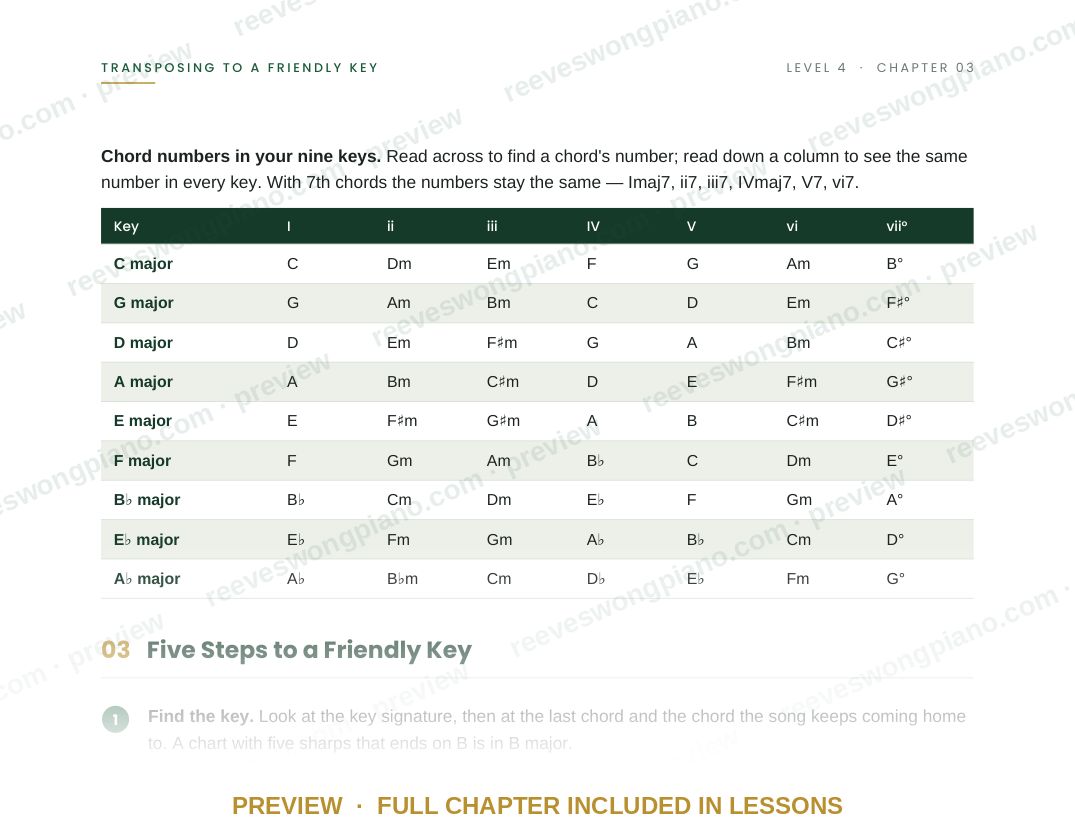
A singer hands you a chart in B. A guitarist calls a song in D♭. A ballad sits too high for the voice. You do not need to master every key to play it — you move the song into a key your hands already know. Here is a five-step method for any lead sheet.
In this chapter you will learn to
- Turn any chord chart into chord numbers — I ii iii IV V vi vii°, or 1 2 3 4 5 6 7.
- Move a song into a friendly key step by step, keeping every chord quality and slash bass.
- Move a song up or down to suit a singer.
- Recognise the key signatures of B, D♭, F♯ and G♭, and know that F♯ and G♭ are the same keys on the piano.
- Name the key signature and relative minor of all twelve major keys from one table.
Chords 4 chapters
04Passing Diminished Chords6 pages
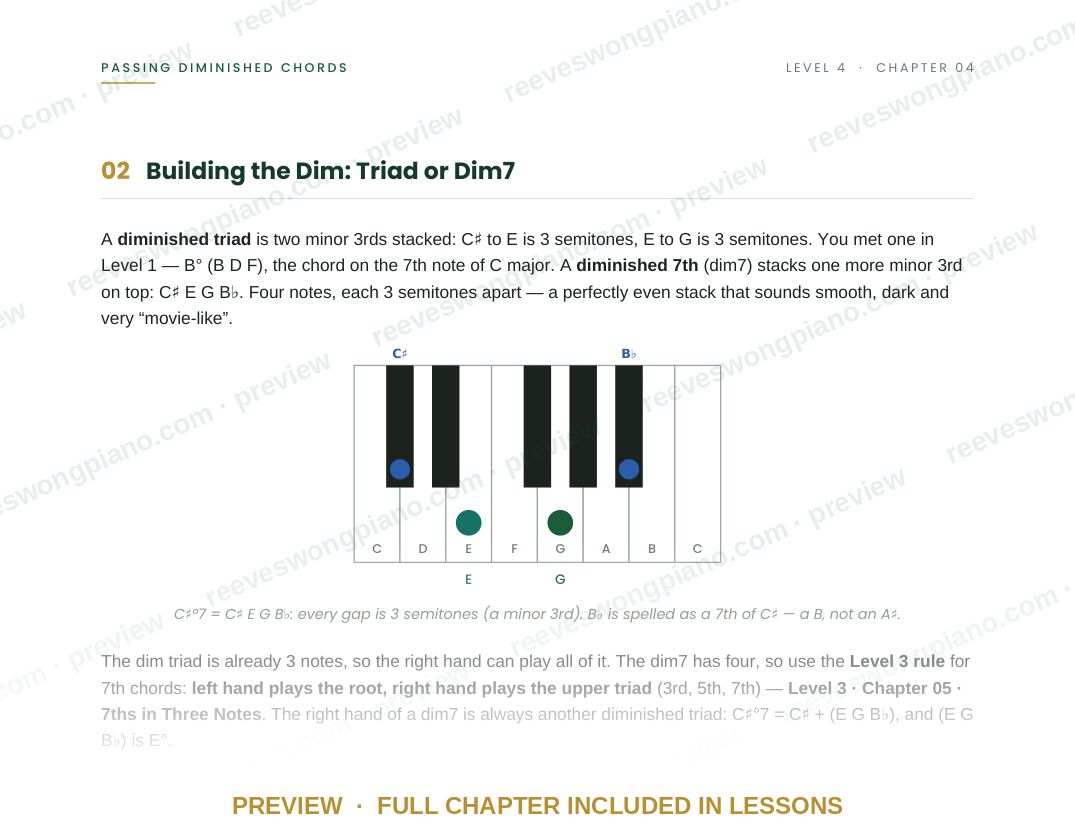
You already play the chords that belong to the key. A passing diminished chord is a quick visitor from outside: it slips in between two of those chords for half a bar, makes the bass climb one semitone at a time, and leaves. It is one of the easiest ways to make a plain chart sound like a real arrangement.
In this chapter you will learn to
- Spot the places where a passing dim fits: two chords whose roots are a tone apart.
- Build the dim on the note in between — C – C♯dim – Dm.
- Play it as a 3-note dim triad, or as a dim7 (left-hand root + right-hand upper triad).
- Read every way a chart writes it: C♯dim, C♯°, C♯dim7, C♯°7, C♯o7.
- Add passing dims to a pop progression — and to a song you are learning this week.
056th Chords & the Line Cliché7 pages
Two small moves with a big, familiar sound. A 6th chord adds one sweet note to a chord you already know. A line cliché keeps one chord still while a single line creeps down — or up — by semitones underneath or on top. You have heard both in hundreds of songs; this week you will play them.
In this chapter you will learn to
- Build C6, F6, G6, Am6 and Fm6 and play each in three notes (LH root + RH 3rd, 5th, 6th).
- Know when a chart shows a 6th — and what to do when it does.
- Play the minor line cliché: Am – Am/G♯ – Am/G – Am/F♯ → F.
- Play the major line cliché: C – C+ – C6 – C7 → F.
- Put a line cliché into a song wherever a chart holds one chord for a long time.
06The Surprise Major Chord6 pages
Sometimes a chart in C shows a chord that does not belong — an E, an A7, a D. It is not a mistake. It is one of the most-used sounds in pop: a bright major chord that appears out of nowhere and pulls you into the next chord. Learn one rule and you will always know where it is going.
In this chapter you will learn to
- Spot a major chord (or a 7) that is not in the key.
- Know where it goes — the chord a 5th below: E7 → Am, A7 → Dm, D7 → G, C7 → F, B7 → Em.
- Play it as a triad, as a 7th (LH root + RH upper triad), or with the 3rd in the bass (E/G♯).
- Hear the one note from outside the key and where it leads.
- Add a surprise major chord to a song you are learning this week.
07The Sad Minor iv6 pages
Play F, then F minor, then C. That little sigh in the middle — one note sinking a semitone — is one of the most emotional sounds in pop. It is borrowed from the minor key, it costs you one finger, and it can turn an ordinary ending into the moment everyone remembers.
In this chapter you will learn to
- Turn F into Fm by lowering one note (A → A♭), and land on C.
- Know where it comes from: C minor, the key that shares C's home note.
- Play the favourite moves: F – Fm – C, C – F – Fm – C and C – Fm – G – C.
- Add the two other borrowed chords, B♭ (♭VII) and A♭ (♭VI), and play the cinematic A♭ – B♭ – C.
- Find the minor iv in a song — and add it to one that doesn't have it.
Patterns 3 chapters
08The 1–5–8–10–12–10–8–5 Pattern8 pages
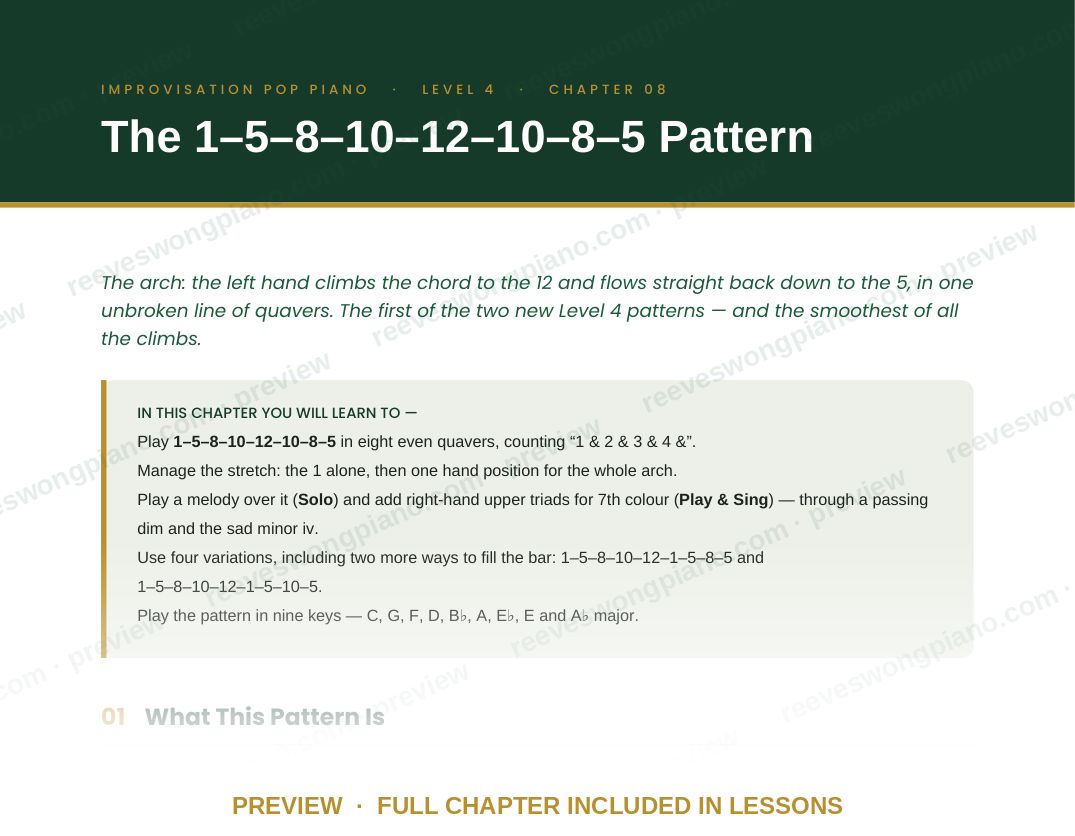
The arch: the left hand climbs the chord to the 12 and flows straight back down to the 5, in one unbroken line of quavers. The first of the two new Level 4 patterns — and the smoothest of all the climbs.
In this chapter you will learn to
- Play 1–5–8–10–12–10–8–5 in eight even quavers, counting “1 & 2 & 3 & 4 &”.
- Manage the stretch: the 1 alone, then one hand position for the whole arch.
- Play a melody over it (Solo) and add right-hand upper triads for 7th colour (Play & Sing) — through a passing dim and the sad minor iv.
- Use four variations, including two more ways to fill the bar: 1–5–8–10–12–1–5–8–5 and 1–5–8–10–12–1–5–10–5.
- Play the pattern in nine keys — C, G, F, D, B♭, A, E♭, E and A♭ major.
09The R–1–5–8–10 Pattern8 pages
Depth and lift together: one deep bass note, then the left hand climbs the open chord to the 10 and lets it ring. The second new Level 4 pattern — built for choruses and big arrivals.
In this chapter you will learn to
- Play any chord as R–1–5–8–10: a low root, then root, fifth, octave and tenth an octave above.
- Count it “1 & 2 & 3 (4)”: four quavers, then the 10 held as a minim.
- Manage the two big moves: the octave leap from R to 1, and the stretch to the 10.
- Play a melody over it (Solo) and add right-hand upper triads (Play & Sing) — through a passing dim and the sad minor iv.
- Use four variations, and play the pattern in nine keys — C, G, F, D, B♭, A, E♭, E and A♭ major.
10Mixing Patterns in a Song7 pages
A whole song in one left-hand pattern sounds flat, however good the pattern. Real arrangements change pattern with the song's sections — quiet in the verse, fuller in the chorus. This chapter shows how to choose, how to switch without stumbling, and how to shape a whole song.
In this chapter you will learn to
- Sort every left-hand pattern of the course from still to full.
- Choose a pattern for each section: intro, verse, pre-chorus, chorus, bridge, outro.
- Switch cleanly at a section boundary: simplify the last beat, an approach note, the push, or the same root with a new shape.
- Build intensity across a whole song — and save the fullest sound for the last chorus.
- Play a 16-bar song with a different pattern in each section.
Finishing 4 chapters
11Intros8 pages
The first four bars decide whether people lean in. A good intro sets the key, the speed and the mood, and tells the singer exactly when to come in. It also takes very little new skill: you build it from the song itself.
In this chapter you will learn to
- Explain what an intro has to do, and why it is built from the song's own material.
- Play four intro recipes: the last line of the chorus, the chord loop, a pedal-note intro and a fill-led pickup.
- Choose how long an intro should be, and end it so the verse arrives.
- Count in a singer and give them their first note.
- Pick the right intro for a ballad, a mid-tempo song or an up-tempo sing-along.
12Endings8 pages
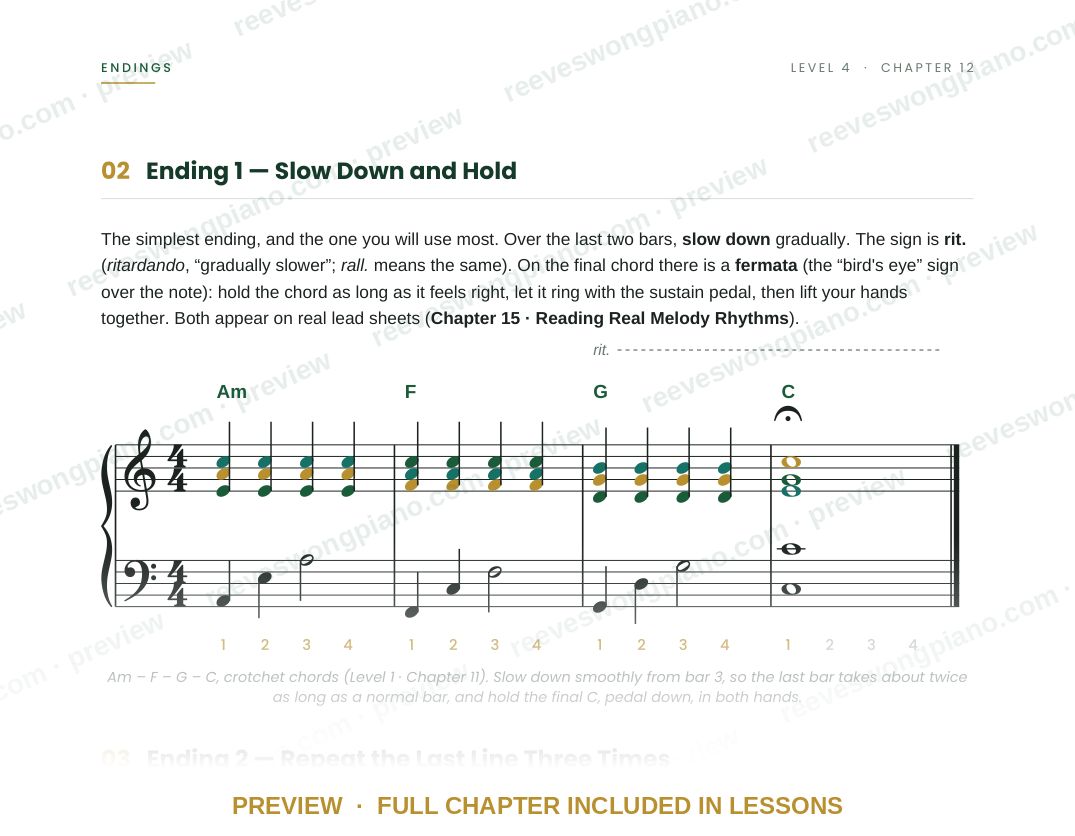
Most players can start a song. Fewer can finish one so that the room knows it is over and wants to clap. An ending is a small piece of drama: build a little tension, then land on I with a sense of arrival.
In this chapter you will learn to
- Slow down and hold the last chord: ritardando and the fermata.
- Repeat the last line three times, with a fake-out the second time.
- Darken the ending with the sad minor iv (IV – iv – I), or widen it with ♭VI – ♭VII – I.
- Finish with a roll or an arpeggio up the keyboard, on a plain or colour chord (add9, maj7, 6).
- Plan a whole ending: setup, build, climax, close.
13The Last-Chorus Key Change7 pages
The last chorus comes round, and suddenly everything is one step higher: brighter, more urgent, and the singer sounds even bigger. It is one of pop's oldest tricks, and on the piano it takes one bar of preparation.
In this chapter you will learn to
- Move the last chorus up a semitone or a tone, and choose the new key.
- Prepare it with a pivot bar: one bar of the new key's V7.
- Tell a pivot change from a sudden “truck driver” change, and play both.
- Read a key change on a lead sheet: a new key signature, accidentals, or chord symbols that jump up.
- Play an 8-bar passage across the change, with every chord spelt correctly in the new key.
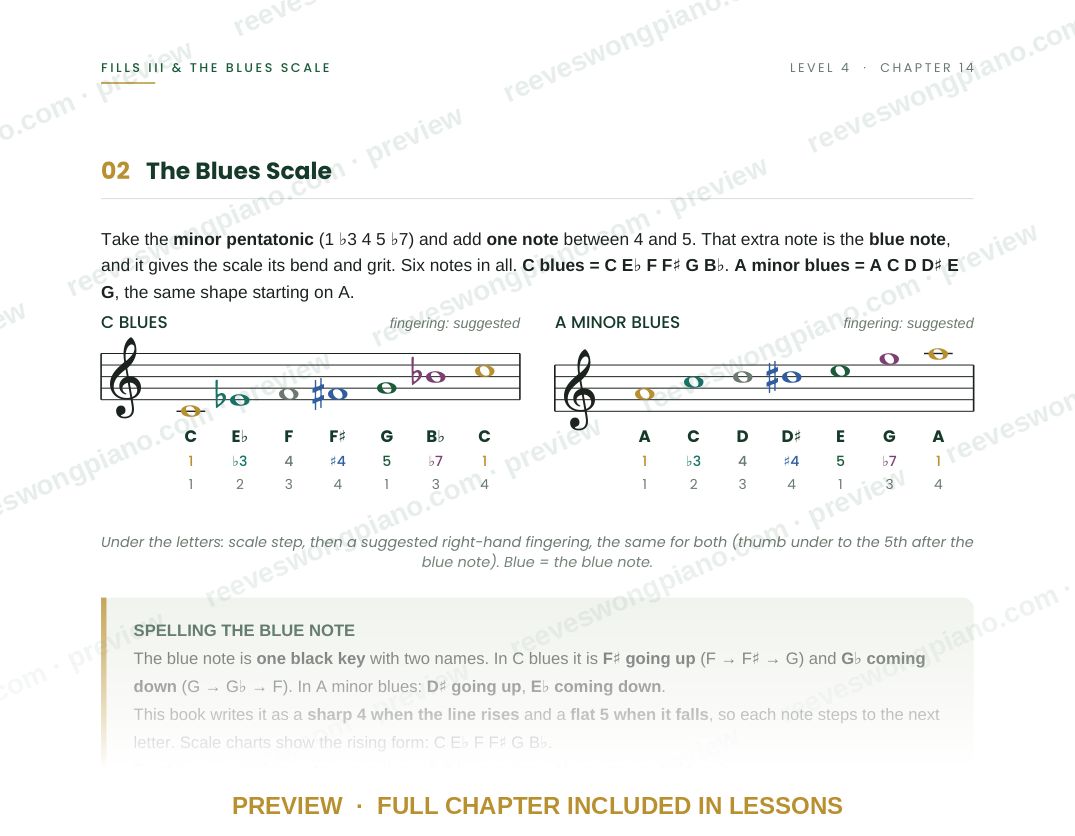
14Fills III & the Blues Scale8 pages
Your fills already land in the right place. Now they get attitude: the bluesy bend of the blues scale, the weight of octaves, both hands at once, and the big run that launches the last chorus. You will also learn when to leave a gap empty.
In this chapter you will learn to
- Build the blues scale (C blues, A minor blues) and spell its blue note correctly.
- Play blues fills over ordinary pop chords, passing through the blue note without stopping on it.
- Play octave fills and two-hand fills (hand-over-hand and unison).
- Launch a chorus with the big lift, a rising run that lands on beat 1.
- Decide when not to fill, and plan the fills across a whole song.
Real Songs 6 chapters
15Reading Real Melody Rhythms8 pages
Real lead sheets are written from real singers — and singers push, delay and squeeze their words. The chords are usually easy; the rhythm of the vocal line is what makes a song look hard. This chapter gives you a method that turns any busy bar into something you can count, clap and play.
In this chapter you will learn to
- Count any dense vocal bar with the five-step method: beats → “1 e & a” → ties → clap → by ear.
- Recognise the eight rhythm cells that make up most real melodies, and count each one.
- Keep your place through an odd 2/4 bar inside a 4/4 song.
- Read fermatas, rit. and a tempo — and come back in together after a pause.
- Find your way through repeats, D.S. and the coda on a real chart.
16Reading Real Lead Sheets8 pages
Book examples are tidy. Real lead sheets — downloaded, photocopied, typed by a stranger — are not: one chord has five spellings, symbols carry 9s and 13s, two chords share a bar and the road map jumps around. This chapter teaches you to read any of them and know exactly what to play.
In this chapter you will learn to
- Read every common spelling of a chord symbol and play it in three notes.
- Turn 9, 11 and 13 chords into a 7th or add9 you already know.
- See exactly where each chord changes: two chords in a bar, slashes, rhythm hits and pushes.
- Follow repeats, endings and pickup bars, and use accidentals as clues to colour chords.
- Give any new chart a two-minute first look before you play a note.
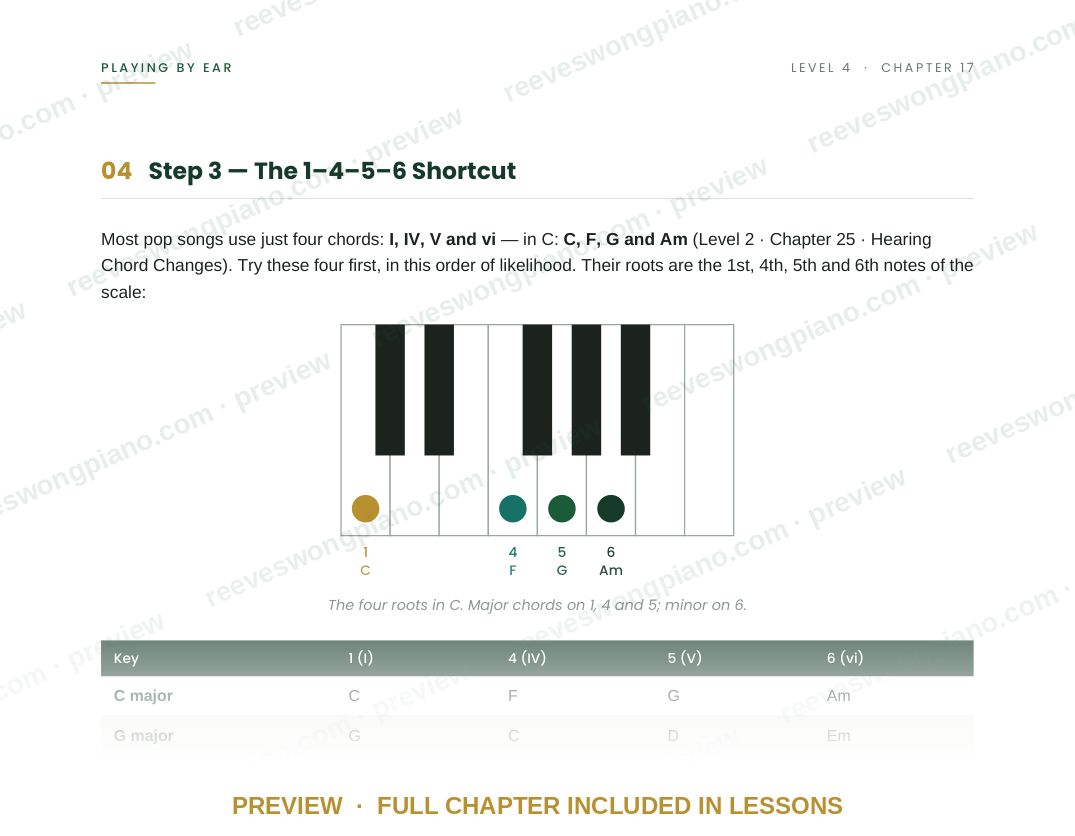
17Playing by Ear7 pages
Playing by ear is not a gift some people are born with — it is a short list of questions you ask the music, in the right order. Pop makes it easier than any other style: most songs use the same four chords. This chapter gives you the questions and a daily routine with tunes you already know.
In this chapter you will learn to
- Find the key of a song from its last note and chord — the note that feels like home.
- Find the bass note one chord at a time, and turn it into a chord.
- Use the 1–4–5–6 shortcut and check your chords with the Level 1 loops.
- Find a melody from its first note by steps and leaps.
- Recognise the sad, the bright and the tense chords of Level 4 by their sound.
18Arranging a Song from Scratch11 pages
This is where everything comes together. Give a Level 4 pianist any pop lead sheet — a melody, some chord symbols, nothing else — and they can turn it into a finished solo-piano arrangement. Here is the method, step by step, worked through on one song from the bare chart to the final score.
In this chapter you will learn to
- Take any lead sheet and choose the key you will play it in.
- Map the song's form and give each section its own left-hand pattern.
- Put the melody on top with three-note harmony on the long notes.
- Add colour chords — 7ths, add9, a passing diminished chord, the sad minor iv — where they fit.
- Finish the arrangement with an intro, fills at the phrase ends and an ending.
19Hearing Colour7 pages
Level 4 has given you five new colours: the passing dim, the surprise major chord, the sad minor iv, the 6th chord and the last-chorus key change. Now train your ear to recognise them — in your own playing, in a recording, and in a song you are trying to work out by ear.
In this chapter you will learn to
- Describe each of the five colours in words, and say what changes.
- Hear a passing dim by its creeping bass, and a surprise major chord by its bright lift.
- Hear the minor iv's sigh, and tell a 6th chord from a maj7.
- Notice a key change and say whether the song moved up a semitone or a tone.
- Name the colour in a loop and in a real recording.
20Final Performance11 pages
This is it — the last chapter of the course. Two years ago you found middle C. Now you can take a song, give it an intro, colour its chords, lift its last chorus into a new key and end it like a record. Here is your graduation piece: learn it, polish it, and perform it.
In this chapter you will learn to
- Play a complete solo-piano arrangement from intro to final chord, with the melody on top.
- Switch between two Level 4 left-hand patterns: R–1–5–8–10 in the verse, 1–5–8–10–12–10–8–5 in the chorus.
- Colour the chorus with 7ths, a passing diminished chord and the sad minor iv.
- Play a fill into the chorus and lift the last chorus up a tone with a pivot bar.
- Finish with a cinematic ending — and plan what you will play next.
Start Your Lessons
Complete beginner or returning player, message me with your experience and I'll tell you where you'd start.
+65 8876 3831