
Home / Curriculum / Level 3
Curriculum · Level 3 · Months 13–18
Level 3 Chapters
The third six months of the course. 28 chapters bring in the sound of modern pop: 7th chords played in three notes, syncopation and semiquaver grooves, the 2–5–1 and turnarounds, five new left-hand patterns and three-note harmony.
Chapter by chapter
Each chapter is a short illustrated guide with diagrams, notation and exercises to check yourself.
In the order that suits you
I pick the chapters for each lesson around your songs, so we don't always go in number order.
Ticked off on your map
Every chapter we cover is ticked on your Level 3 progress map, which you get with each lesson summary.
Look Inside
A few pages from Level 3. Students receive every chapter in full as part of their lessons. Tap a page to enlarge it.
All Level 3 Chapters
Grouped by the five skill lines on your progress map. Tap a chapter to see what it covers.
Rhythm & Style 5 chapters
10Syncopation9 pages
Pop rarely sits squarely on the beat — it leans into it. Syncopation moves the accent onto the off-beats, and the push, a chord that arrives one quaver early, is the sound of almost every pop song.
In this chapter you will learn to
- Explain syncopation: an accent on a weak beat or off-beat, or a note held across a strong beat.
- Count quavers “1 & 2 & 3 & 4 &” and tell strong beats from off-beats.
- Read and play tied quavers across the beat and the quaver–crotchet–quaver figure.
- Play the push (anticipation): a chord on the “&” of 4, tied over the barline.
- Add pushes to right-hand chord rhythms over a progression with 7th chords.
16Semiquavers & the 16th-Note Feel7 pages
Split every beat into four and the music starts to bounce. Semiquavers are the engine of modern pop and R&B — counted “1 e & a”, beamed in fours, and played lightly with a laid-back feel.
In this chapter you will learn to
- Count semiquavers “1 e & a 2 e & a …” against a steady beat.
- Read semiquavers, semiquaver rests and the dotted quaver + semiquaver.
- Recognise the eight one-beat cells and how they are beamed in groups of four.
- Play four semiquaver chord rhythms in the right hand.
- Play a 16th-note pop / R&B groove with 7th chords and the 3+3+2 Octave Bass.
20Left-Hand Styles7 pages
The right hand carries the melody or the chords; the left hand gives a song its groove and foundation. You now own twelve left-hand patterns — this chapter puts them side by side and shows you how to choose.
In this chapter you will learn to
- Play every left-hand pattern from Levels 1–3 in C, from memory.
- Say which patterns carry the full chord (the 3rd) and which need the right hand to supply it.
- Match a pattern to a song's time signature, tempo and feel.
- Recognise the classic textures — block chords, boom-chuck, broken chords, Alberti bass, waltz.
- Keep a pattern's shape while following the roots, and change pattern between verse and chorus.
21Swing & Shuffle9 pages
Play two quavers long–short instead of even and the music starts to lilt. That lopsided, laid-back lilt is swing, and its heavier, rolling cousin is the shuffle. Both come straight out of the triplet you already know.
In this chapter you will learn to
- Hear and play the difference between straight and swung quavers, counted “1 (trip) let”.
- Read the Swing / Shuffle marking on a chart and play written quavers long–short.
- Tell a light swing feel from a heavy, driving shuffle.
- Play the 1–5 / 1–6 shuffle left hand on C, F and G, and swing the patterns you know.
- Add swung right-hand chord rhythms with 7th chords, and play an 8-bar shuffle.
22Grooves & Styles7 pages
You have the patterns, the rhythms and the colours. A groove is how you combine them so that a song sounds like a ballad, a rock song or a slow jam — six recipes to play, hear and adapt.
In this chapter you will learn to
- Describe a groove by its four ingredients: tempo, left hand, right hand and touch.
- Play a ballad, a pop-rock groove in driving quavers and an R&B / neo-soul groove in semiquavers with 7ths.
- Play a 6/8 ballad, a half-time feel and a 12/8 ballad.
- Choose a groove for each section of a song, and switch between grooves.
Keys & Harmony 6 chapters
12A Major — Scale & Diatonic Chords9 pages
A major is a bright, guitar-friendly key used throughout pop, rock and folk. It has three sharps — F♯, C♯ and G♯ — yet the hand keeps exactly the same shape as C major in both directions. Here you learn its scale, its triads and its 7th chords, and meet its relative minor, F♯ minor.
In this chapter you will learn to
- Name the seven notes of A major and read its key signature of three sharps (F♯ C♯ G♯).
- Play the A major scale over two octaves with the fingering — each hand alone, then together.
- Build the seven diatonic triads and the seven diatonic 7th chords of A major, each 7th as left-hand root + right-hand upper triad.
- Play the relative minor, F♯ minor, in its natural and harmonic forms.
- Play easy progressions in A and F♯ minor, in triads and in 7ths, with smooth changes.
13The 2–5–18 pages
The 2–5–1 (or ii–V–I) is the most important progression in jazz and a backbone of pop, Mandopop and R&B — three chords, on the 2nd, 5th and 1st degrees of the key, that always sound like they are heading home. In Level 3 you play it with 7th chords: left-hand root, right-hand upper triad.
In this chapter you will learn to
- Explain why it is called the 2–5–1 and find the ii, V and I in any Level 3 key.
- Play ii7 – V7 – Imaj7 as left-hand root + right-hand upper triad.
- Move through it with smooth shapes — the 3rd of each chord stays to become the next chord's 7th.
- Play the 2–5–1 in C, G, F, D and B♭, and find it in A and E♭.
- Spot 2–5–1s (and ii–Vs) in a chord chart or lead sheet.
14Turnarounds7 pages
A turnaround is a short progression — often the last bar or two of a section — that “turns the music around” and sends the ear back to the top. It is what makes a loop feel inevitable, and it lives in jazz, blues, pop and Mandopop alike.
In this chapter you will learn to
- Explain what a turnaround does and where it goes — the end of a section, before a repeat.
- Play the classic I – vi – ii – V as triads and as 7th chords, with smooth shapes.
- Play the extended iii – vi – ii – V and the doo-wop I – vi – IV – V.
- Play turnarounds in C, G, F and D — one chord per bar, or two.
- Use a turnaround in a 1st-time bar to lead back to the top of a repeat.
18E♭ Major — Scale & Diatonic Chords9 pages
E♭ major is a rich, mellow key common in soul, gospel and horn-driven pop. It has three flats — B♭, E♭ and A♭ — and, like B♭ major, its home note is a black key, so both hands begin away from the thumb. Here you learn its scale, its triads and its 7th chords, and meet its relative minor, C minor.
In this chapter you will learn to
- Name the seven notes of E♭ major and read its key signature of three flats (B♭ E♭ A♭).
- Play the E♭ major scale over two octaves with the fingering — each hand alone, then together.
- Build the seven diatonic triads and the seven diatonic 7th chords of E♭ major, each 7th as left-hand root + right-hand upper triad.
- Play the relative minor, C minor, in its natural and harmonic forms.
- Play easy progressions in E♭ and C minor, in triads and in 7ths, with smooth changes.
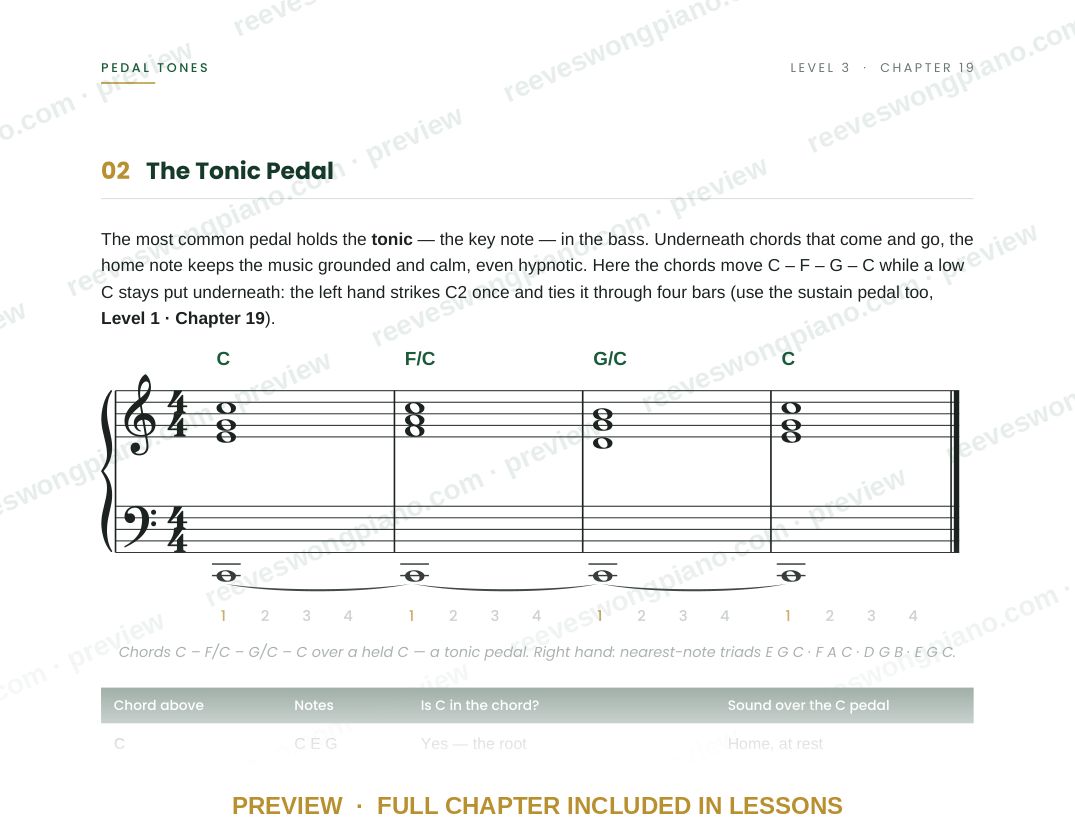
19Pedal Tones6 pages
One note held or repeated — usually deep in the bass — while the chords move above it. The note stays put even when it no longer belongs to the chord, and that gentle friction creates tension, drama and a powerful sense of anchoring.
In this chapter you will learn to
- Explain what a pedal tone (pedal point) is — and that it is not the sustain pedal.
- Play a tonic pedal under changing right-hand triads, held and repeated.
- Play a dominant pedal that builds tension and resolves home.
- Write a pedal as a run of slash chords, in all seven Level 3 keys.
- Keep one note on top of the right hand — the top-note pedal.
24Pop Progressions III8 pages
You already know the core pop loops as triads (Level 1) and with walking slash-chord basses and minor keys (Level 2). Level 3 colours them: a maj7, an m7 or an add9 on the right chord turns a basic loop into something that sounds produced. Same loops, same left hand — richer colour.
In this chapter you will learn to
- Choose the right colour for each chord of a pop loop — and say why it works.
- Play the four-chord song and three other pop loops in colour, with smooth three-note shapes.
- Play the Royal Road in 7ths and 7th chords over a walking slash-chord bass.
- Colour minor-key loops with m7, maj7 and the harmonic-minor V7.
- Move a coloured loop into any Level 3 key.
7th Chords 7 chapters
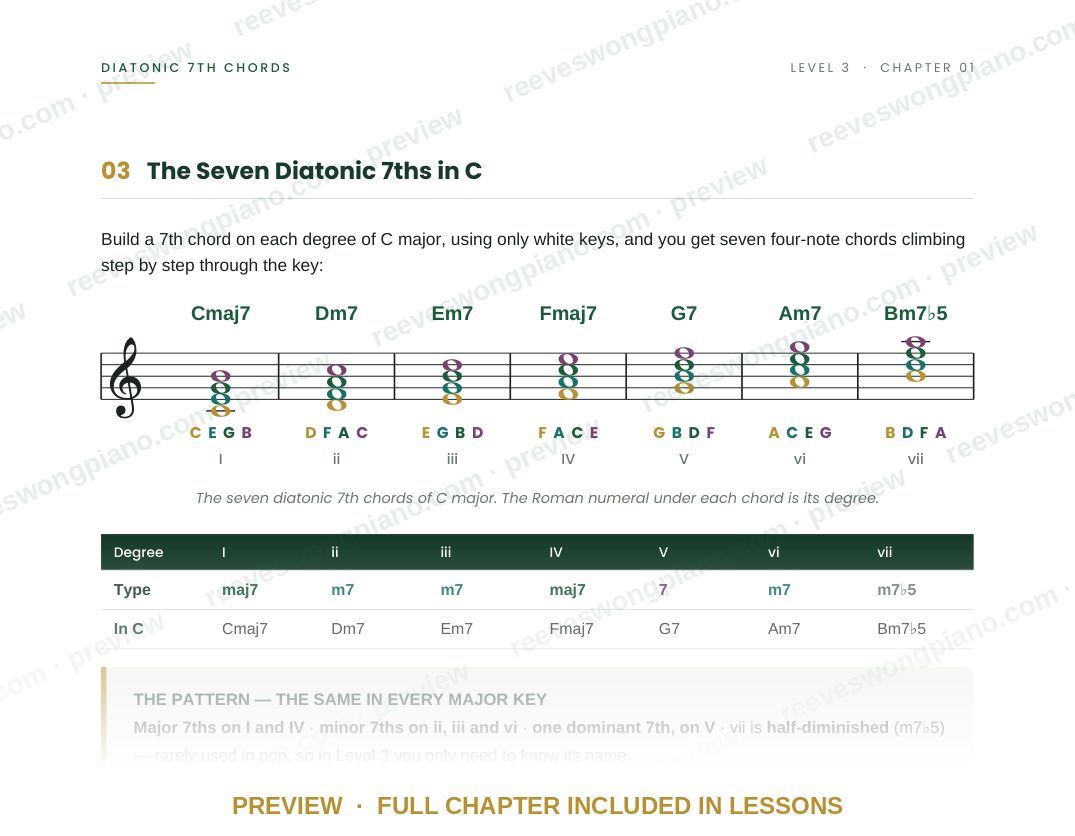
01Diatonic 7th Chords6 pages
Every chord in Levels 1 and 2 was a triad — three notes stacked in 3rds. Stack one more 3rd on top and you get a 7th chord: the warm, rich colour of soul, R&B, jazz and modern pop, and the sound that gives Level 3 its name. This chapter shows how 7ths are built and which one lives on each degree of the key.
In this chapter you will learn to
- Build a 7th chord by stacking one more 3rd on top of a triad.
- Tell the four types apart — maj7, m7, dominant 7 and m7♭5 — by their triad and their 7th.
- Name the seven diatonic 7th chords of C, G and F major, and the pattern they always follow.
- Play any diatonic 7th the Level 3 way: left-hand root, right-hand upper triad.
- Upgrade a plain triad progression into a 7th-chord progression.
02Major 7th Chords7 pages
A major 7th chord is a major triad with one extra note on top — the 7th note of the scale, sitting just a semitone below the octave. Cmaj7 = C – E – G – B. The result is warm, dreamy and at rest: the signature sound of jazz, bossa nova, R&B and lo-fi, and of many a soft pop ending.
In this chapter you will learn to
- Hear and describe the warm, restful sound of a major 7th.
- Build a maj7 on any root: major triad + major 7th, a semitone below the octave.
- Read every way a lead sheet writes it: Cmaj7, CM7, CΔ7.
- Find the two maj7 chords in every Level 3 key — on I and IV.
- Play any maj7 as LH root + RH minor triad on the 3rd, and use it in progressions.
03Minor 7th Chords7 pages
A minor 7th chord is a minor triad with a flat 7th on top. Am7 = A – C – E – G. Smooth, mellow and a little wistful, it is the workhorse chord of pop, R&B, funk and jazz — the sound of the ii, iii and vi chords, and the most common 7th chord of all.
In this chapter you will learn to
- Hear and describe the mellow, soulful sound of a minor 7th.
- Build a m7 on any root: minor triad + minor 7th, a tone below the octave.
- Read every way a lead sheet writes it: Cm7, C-7, Cmin7 — and never confuse it with CM7.
- Find the three m7 chords in every Level 3 key — on ii, iii and vi.
- Play any m7 as LH root + RH major triad on the 3rd, and use it in vamps and turnarounds.
04Dominant 7th Chords7 pages
A dominant 7th chord is a major triad with a flat 7th on top. G7 = G – B – D – F. Bright but restless, it carries a built-in tension that wants to resolve — the engine behind cadences and the heart of the blues. It is the only 7th chord written with just a number: G7.
In this chapter you will learn to
- Hear and describe the bright, restless pull of a dominant 7th.
- Build a dominant 7th on any root: major triad + minor 7th.
- Read the symbol — just the number: G7, C7, D7 — and never confuse it with Gmaj7.
- Find the one dominant 7th in every Level 3 key (V7) and hear its tritone pull home to I.
- Play any dominant 7th as LH root + RH diminished triad on the 3rd.
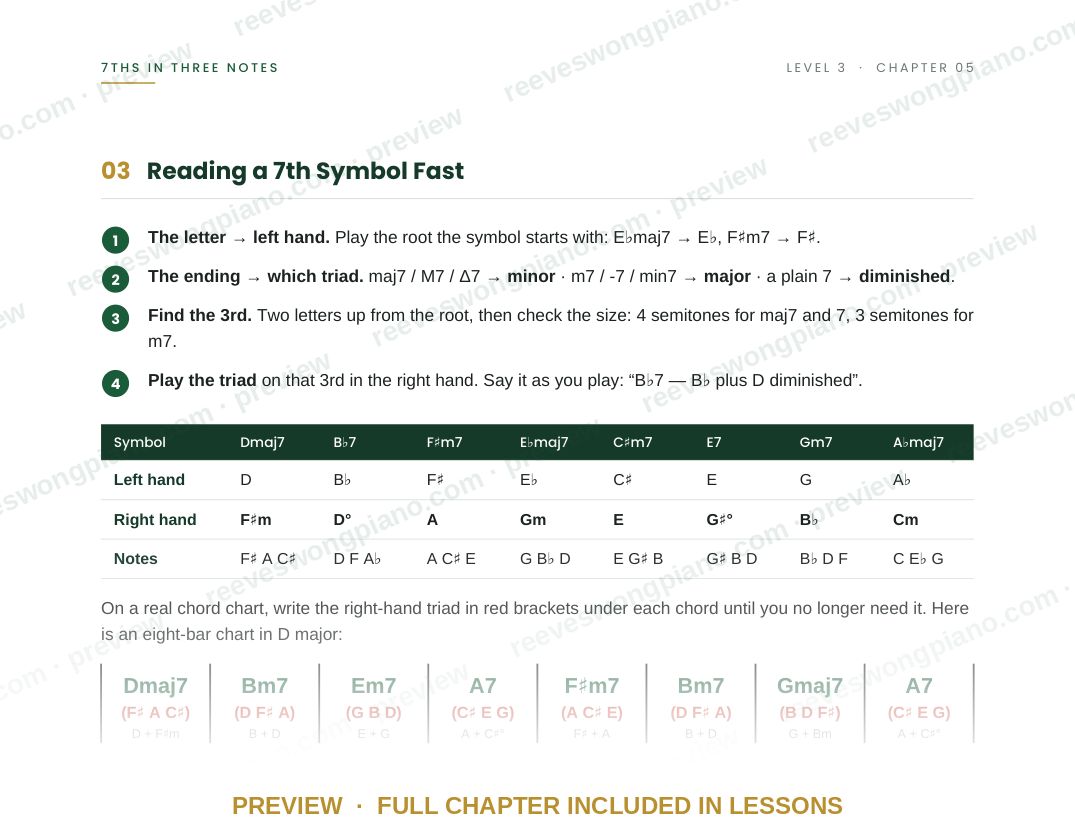
057ths in Three Notes7 pages
This chapter is the method behind every 7th chord in Level 3. Instead of grabbing four notes, play the root in the left hand and a simple triad — one you have known since Level 1 — in the right. Three short rules turn any 7th symbol into that triad in a second.
In this chapter you will learn to
- Explain why Level 3 plays every 7th as LH root + RH upper triad.
- Use the three rules: maj7 → minor triad, m7 → major triad, 7 → diminished triad — all on the 3rd.
- Find the upper triad of every diatonic 7th in C, G, F, D, B♭, A and E♭.
- Read a 7th symbol on a lead sheet and play it straight away.
- Drill the method until it is automatic.
06Smooth 7th Changes6 pages
In Chapter 05 every upper triad sat in root position, so the right hand hopped from shape to shape. Now apply what you learned in Level 2 · Chapter 05 · Smooth Chord Changes to the upper triads: keep the notes two chords share, slide the others to the nearest note — and 7th-chord progressions start to glide.
In this chapter you will learn to
- Invert the right-hand upper triad so each 7th chord is as close as possible to the one before.
- Find the common tones between two 7th chords' upper triads and keep them still.
- Predict how many notes move from how far the roots move.
- Play Dm7–G7–Cmaj7, Cmaj7–Am7–Dm7–G7 and Fmaj7–Em7–Dm7–Cmaj7 smoothly — and the same in G and F.
- Write the nearest shapes in red brackets on a chord chart.
09Add9 & Add2 Chords7 pages
Add one note — the 9th — to a plain chord and it starts to shimmer. The add9 is pop piano's favourite colour chord: open, warm and modern, yet still clearly major or minor.
In this chapter you will learn to
- Build an add9 chord: a triad plus the 9th, with no 7th — and know what add2 means.
- Tell an add9 apart from a sus2 at a glance: does the chord still have its 3rd? Voice it with three notes in the right hand and the root in the left — and know which note to drop.
- Play minor add9 chords, choose where add9 sounds best (I and IV), and find it in all seven Level 3 keys.
Patterns 5 chapters
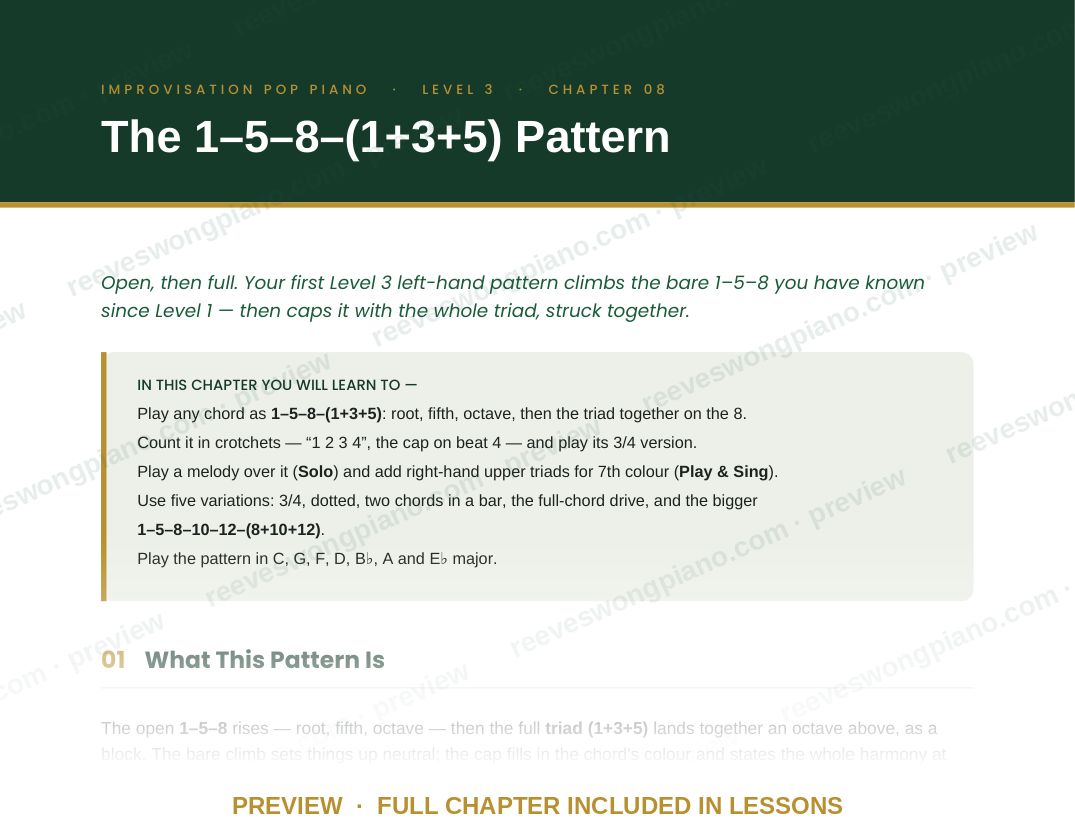
08The 1–5–8–(1+3+5) Pattern8 pages
Open, then full. Your first Level 3 left-hand pattern climbs the bare 1–5–8 you have known since Level 1 — then caps it with the whole triad, struck together.
In this chapter you will learn to
- Play any chord as 1–5–8–(1+3+5): root, fifth, octave, then the triad together on the 8.
- Count it in crotchets — “1 2 3 4”, the cap on beat 4 — and play its 3/4 version.
- Play a melody over it (Solo) and add right-hand upper triads for 7th colour (Play & Sing).
- Use five variations: 3/4, dotted, two chords in a bar, the full-chord drive, and the bigger 1–5–8–10–12–(8+10+12).
- Play the pattern in C, G, F, D, B♭, A and E♭ major.
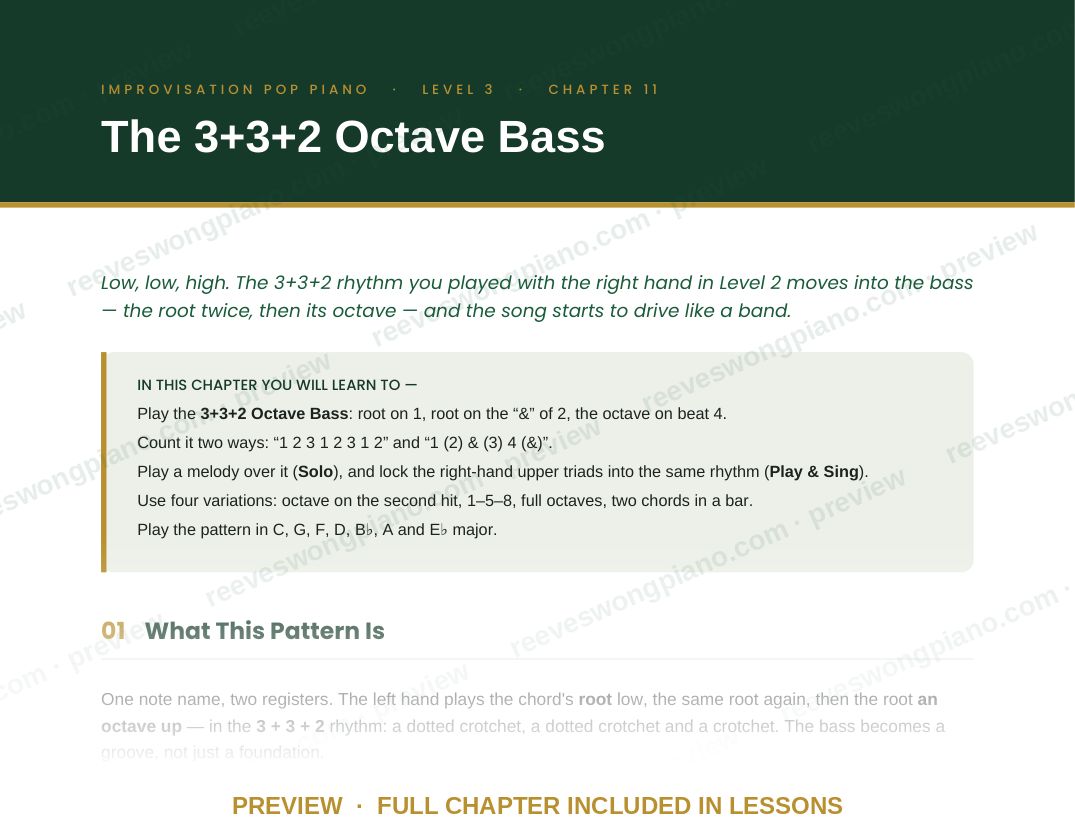
11The 3+3+2 Octave Bass7 pages
Low, low, high. The 3+3+2 rhythm you played with the right hand in Level 2 moves into the bass — the root twice, then its octave — and the song starts to drive like a band.
In this chapter you will learn to
- Play the 3+3+2 Octave Bass: root on 1, root on the “&” of 2, the octave on beat 4.
- Count it two ways: “1 2 3 1 2 3 1 2” and “1 (2) & (3) 4 (&)”.
- Play a melody over it (Solo), and lock the right-hand upper triads into the same rhythm (Play & Sing).
- Use four variations: octave on the second hit, 1–5–8, full octaves, two chords in a bar.
- Play the pattern in C, G, F, D, B♭, A and E♭ major.
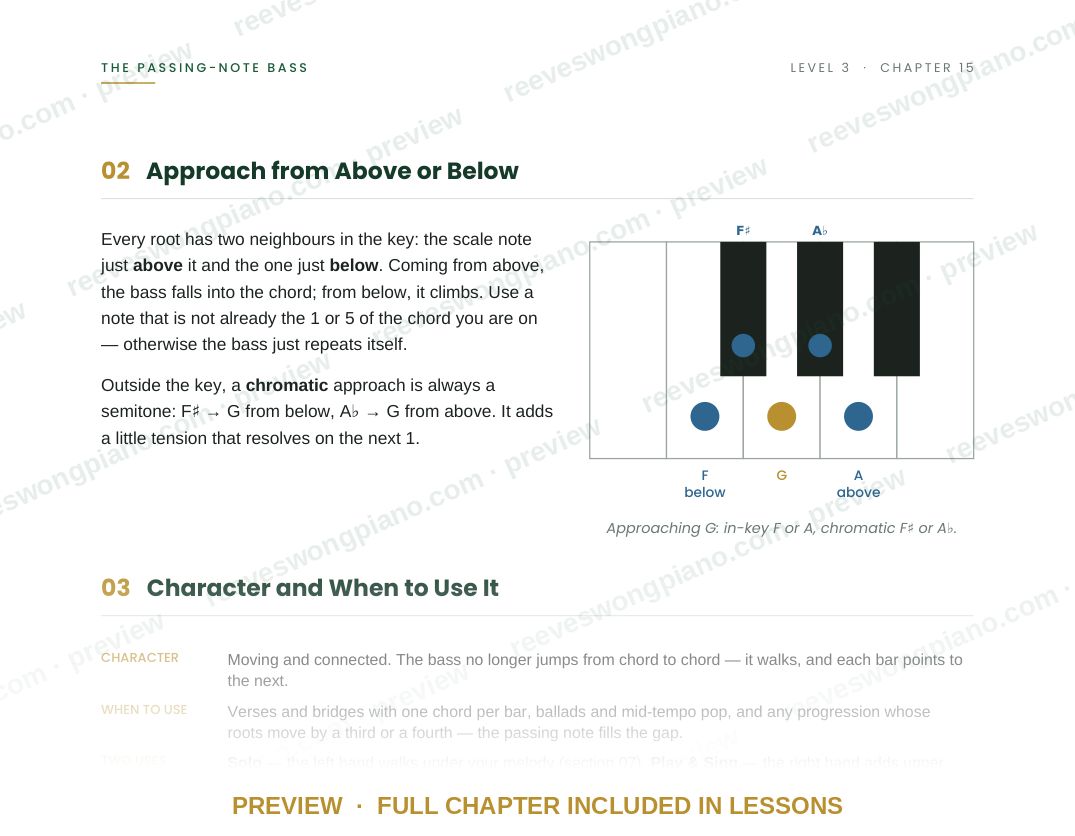
15The Passing-Note Bass7 pages
A bass line that walks. Play 1–5–8 as usual — then, on beat 4, step into the next chord. One new note a bar, and the left hand starts to lead the harmony instead of just following it.
In this chapter you will learn to
- Play 1–5–8 and a passing note on beat 4 — one step from the next chord's root.
- Choose the step: approach from above or from below, a tone or a semitone.
- Use a chromatic approach note (a half step outside the key).
- Play a melody over it (Solo) and add right-hand upper triads for 7th colour (Play & Sing).
- Play the pattern in C, G, F, D, B♭, A and E♭ major.
17The R–(1–5–8–5–8–5) Pattern8 pages
Grounded but flowing. One low bass note, then the open 1–5–8 rolling above it in steady quavers — the roll you have played since Level 1, now with a real bass underneath.
In this chapter you will learn to
- Play any chord as R–(1–5–8–5–8–5): a low root, then the open roll an octave above.
- Count it “1 & 2 & 3 & 4”: six quavers and a crotchet.
- Play a melody over it (Solo) and add right-hand upper triads for the 3rd and the 7th (Play & Sing).
- Use six variations: 3/4, half-bar, the push, adding the 10, and two sister patterns — R–(1–5–8) and R–(1–5–8–5–10–5).
- Play the pattern in C, G, F, D, B♭, A and E♭ major.
23The 1–5–8–5–10–8–(10+12)–8 Pattern7 pages
The last and richest Level 3 pattern: eight quavers that swing between the 5 and the 8, with the 10 and 12 ringing together near the end of the bar. Built from the same five notes as Level 2 · Chapter 20.
In this chapter you will learn to
- Play 1–5–8–5–10–8–(10+12)–8 in eight even quavers, counting “1 & 2 & 3 & 4 &”.
- Name 10 and 12 as the 3rd and 5th an octave up, and strike them together on beat 4.
- Play a melody over it (Solo) and add right-hand upper triads for 7th colour (Play & Sing).
- Adapt it: smaller hands, 3/4, the push, two chords in a bar.
- Play the pattern in C, G, F, D, B♭, A and E♭ major.
Performance 5 chapters
07Three-Note Harmony8 pages
In Level 2 you put one harmony note under the melody. Now add a second one: with three notes in the right hand — the melody on top, two chord tones underneath — a single line turns into a full, arranged sound, while your left hand keeps the bass.
In this chapter you will learn to
- Harmonise a melody in three notes: melody on top, two chord tones directly below, all in the right hand.
- Turn any triad so the melody note is on top — the inversions from Level 2 · Chapter 04.
- Harmonise 7th chords by skipping the root — the upper triad from Chapters 05 and 06, melody on top.
- Decide which melody notes get harmony and which stay single.
- Keep both hands clear of each other, and choose a light, medium or full texture for each part of a song.
25Fills II — Fills Over Chord Changes7 pages
In Level 2 your fills filled a gap. Now they travel: a good fill starts in one chord and steps neatly into the next, so the change sounds planned — like a singer taking a breath and landing on the new word.
In this chapter you will learn to
- Aim every fill at a landing note — a chord tone of the next chord, on beat 1.
- Build chord-tone (arpeggio) fills over 7th chords, and pentatonic fills in A and E♭.
- Fill with the left hand: walk-ups and walk-downs into the next root.
- Choose where a fill goes — the end of a phrase, the long note — and where it doesn't.
- Play an 8-bar piece that uses all three kinds of fill.
26Improvising over 7th Chords7 pages
Over 7th chords, aim for the two notes that give each chord its colour — the 3rd and the 7th — and your solo starts to sound like the chords themselves.
In this chapter you will learn to
- Find and target the 3rd and the 7th of any maj7, m7 or dominant 7th chord.
- Make chord-tone melodies over Cmaj7 – Am7 – Dm7 – G7.
- Join the chords with a simple guide-tone line — notes that move by step or stay.
- Choose which pentatonic to use over each 7th chord.
- Shape a solo with rhythm motifs and call and response — and practise it with a ten-minute routine.
27Hearing 7th Chords7 pages
In Level 2 you learned to hear which chord is playing — I, IV, V or vi. Level 3 has added colour to those chords. Now train your ear to hear the colour itself: is there a 7th, and which kind? Once you can hear it, you can put it in the right place in every song you play.
In this chapter you will learn to
- Hear the difference between a plain triad and a 7th chord.
- Tell maj7, m7 and dominant 7 apart — dreamy, mellow or bluesy.
- Sing the 7th and hear how far below the octave it sits.
- Recognise the ii–V–I by its colours and its bass line.
- Pick out the chord that has the 7th in a loop, and name its type.
28Play and Sing III8 pages
Level 2 ended with a full arrangement of a song. Level 3 gives that arrangement colour: 7th chords in every bar, an add9, two new left-hand patterns, a syncopated right hand and a fill. This is your Level 3 performance — play it, sing it, and make it sound like a record.
In this chapter you will learn to
- Play every 7th chord as left-hand root + right-hand upper triad, with one shape per chord.
- Accompany your voice with the 3+3+2 Octave Bass in the verse.
- Drive the chorus with the 1–5–8–(1+3+5) pattern and right-hand pushes on the “and” of 4.
- Play a fill into the chorus and a turnaround, a ii–V–I and an add9 ending.
- Perform a complete song from start to finish — your Level 3 performance.
Start Your Lessons
Complete beginner or returning player, message me with your experience and I'll tell you where you'd start.
+65 8876 3831