
Home / Curriculum / Level 1
Curriculum · Level 1 · Months 1–6
Level 1 Chapters
The first six months of the course. 31 chapters across five skill lines take you from finding notes on the keyboard to your first improvisation and playing and singing a song.
Chapter by chapter
Each chapter is a short illustrated guide with diagrams, notation and exercises to check yourself.
In the order that suits you
I pick the chapters for each lesson around your songs, so we don't always go in number order.
Ticked off on your map
Every chapter we cover is ticked on your Level 1 progress map, which you get with each lesson summary.
Look Inside
A few pages from Level 1. Students receive every chapter in full as part of their lessons. Tap a page to enlarge it.
All Level 1 Chapters
Grouped by the five skill lines on your progress map. Tap a chapter to see what it covers.
Reading 8 chapters
01Finding Notes on the Keyboard6 pages
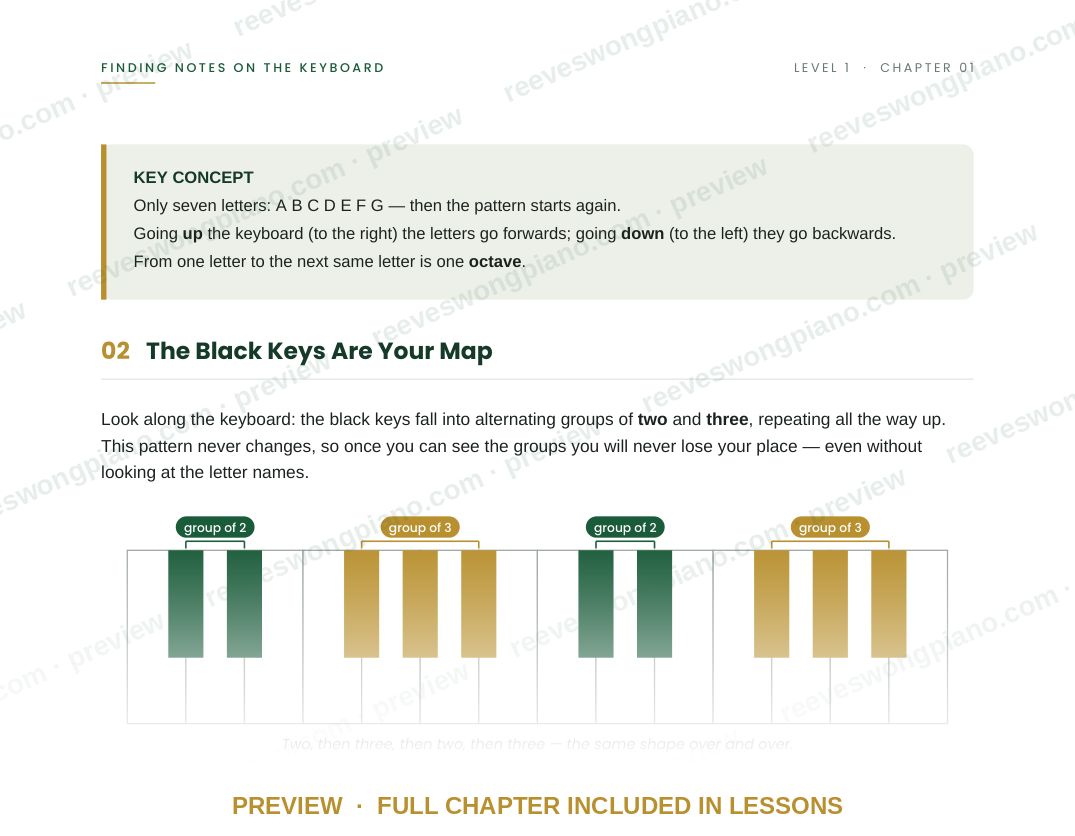
Music can look complicated, but its note names could not be simpler: just seven letters, A to G, repeating over and over. Learn those seven — and the pattern of the black keys — and you can find any note on the piano.
In this chapter you will learn to
- Name the seven letters of the musical alphabet, forwards and backwards.
- Use the groups of two and three black keys as landmarks.
- Find C, F and every other white key in a second, anywhere on the keyboard.
- Find middle C and understand what an octave is.
- Give each black key its two names — a sharp and a flat.
02Piano Fingering5 pages
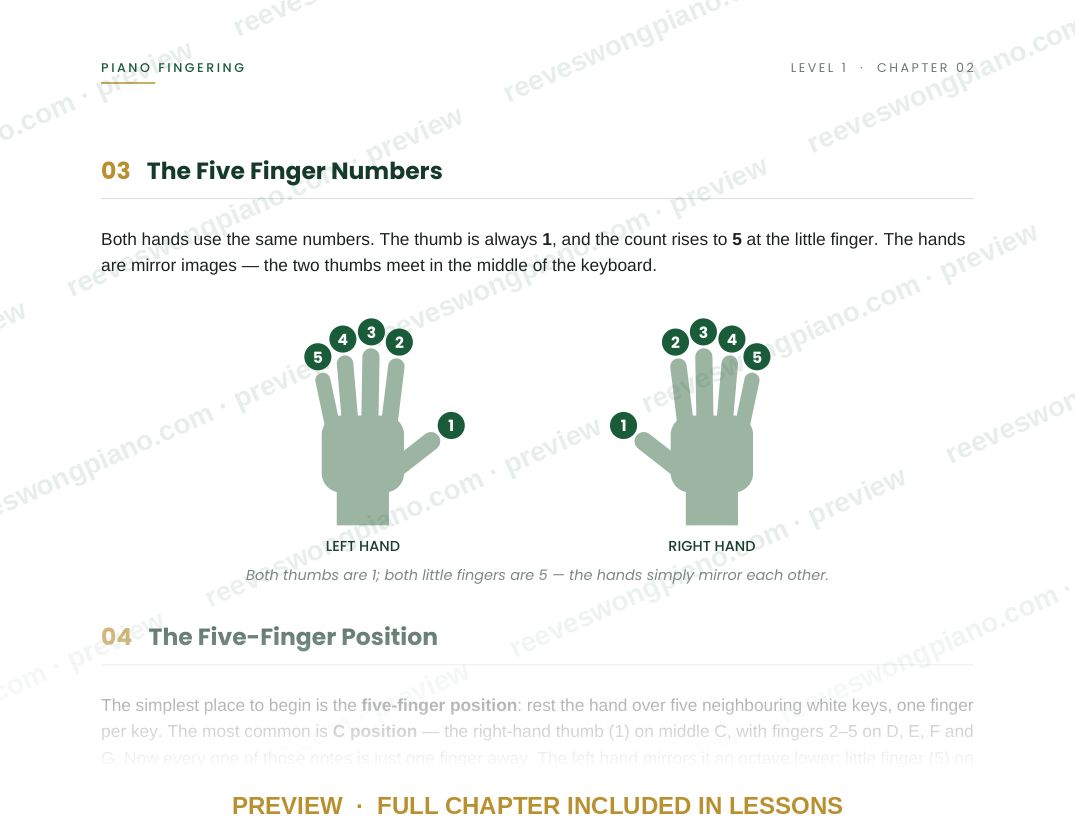
Fingering is the plan for which finger plays which note. Good fingering lets the hand move smoothly and stay relaxed, so the music flows without stumbles or awkward jumps. A few simple rules now will save you years of struggle later.
In this chapter you will learn to
- Number your fingers 1 to 5 in both hands — and know why the hands mirror each other.
- Place both hands in the five-finger position in C and in G.
- Follow the finger numbers printed above the notes.
- Pass the thumb under (and a finger over) to play more than five notes smoothly.
- Keep a relaxed, curved hand shape while you play.
04The Treble Clef6 pages
The treble clef is the elegant, curly symbol at the start of almost every right-hand piano part. It fixes the pitch of every line and space on the staff, so learning to read it is the doorway to reading music. The good news: a couple of simple memory tricks unlock the whole thing.
In this chapter you will learn to
- Recognise the treble clef and know why it is also called the G clef.
- Name every line and space of the treble staff — and find each note on the keyboard.
- Read quickly using three landmark notes: middle C, G and treble C.
- Read the right-hand chords C, F, G and Am as shapes on the staff.
- Check your reading with exercises and a checkpoint.
10Chord Charts6 pages
Most pop musicians don't read every note off the page — they read chords. A chord chart strips a song down to its harmony, telling you which chords to play and when, and trusting you to bring the rest.
In this chapter you will learn to
- Understand what a chord chart is and how it differs from full sheet music.
- Read a chord symbol: its root, quality and extension.
- Know which symbols you play in Level 1 — and what to do with the others for now.
- Count bars and beats in a chart, including bars with two chords.
- Turn a chart into music with the Root + chord pattern.
12The Bass Clef6 pages
Your right hand usually lives up high in the treble clef — but pop piano is driven from below. The bass clef is where your left hand reads the roots, basslines and low chords that hold a song together.
In this chapter you will learn to
- Recognise the bass clef and know why it is also called the F clef.
- Name every line and space of the bass staff — and find each note on the keyboard.
- Read quickly using three landmark notes instead of counting from the bottom.
- Read chord roots and the 1–5–8 and 1+3+5 shapes in the bass clef.
- Check your reading with exercises and a checkpoint.
13Grand Staff Scores5 pages
A grand staff score shows you everything — both hands, every note, exactly as the arranger wrote it. Nothing is left to invent; the work is in reading it well.
In this chapter you will learn to
- Read the two staves of a grand staff as one instrument.
- Name the parts that hold a system together: brace, clefs, time signature, bar lines.
- Find middle C in the gap between the staves.
- Line up the beats and play both hands together from a score.
- Tell a grand staff score apart from a lead sheet — and know when you want each.
17Lead Sheets7 pages
A lead sheet strips a song down to its bones — the melody, the chords and the words. Everything else, the textures and patterns, is left for you to invent at the keys.
In this chapter you will learn to
- Read the three core ingredients of a lead sheet: melody, chord symbols and lyrics.
- Tell a lead sheet apart from a fully written-out grand staff score.
- Play a lead sheet as a solo: right-hand melody, left-hand root.
- Play a lead sheet to accompany your singing: right-hand chords, left-hand root.
- Learn any new lead sheet with a clear step-by-step method.
18Repeat Signs & Endings6 pages
Songs repeat themselves — a verse comes round again, a chorus is sung twice, a riff loops. Instead of writing the same bars out over and over, music uses repeat signs and endings: a few dots and brackets that tell you where to go back to and which way to come out.
In this chapter you will learn to
- Recognise start-repeat and end-repeat barlines.
- Work out the playing order of a repeated passage, bar by bar.
- Read 1st and 2nd endings (first-time and second-time bars).
- Play an eight-bar piece with a repeat and two endings, and follow repeats on a chord chart.
- Know that D.C., D.S. and Coda signs exist — they come in Level 2.
Rhythm 5 chapters
05Notes & Rests6 pages
Every note you read tells you two things: which key to play, and how long to hold it. This chapter is about the second — note values, the rests that match them, and the dot that makes any of them longer.
In this chapter you will learn to
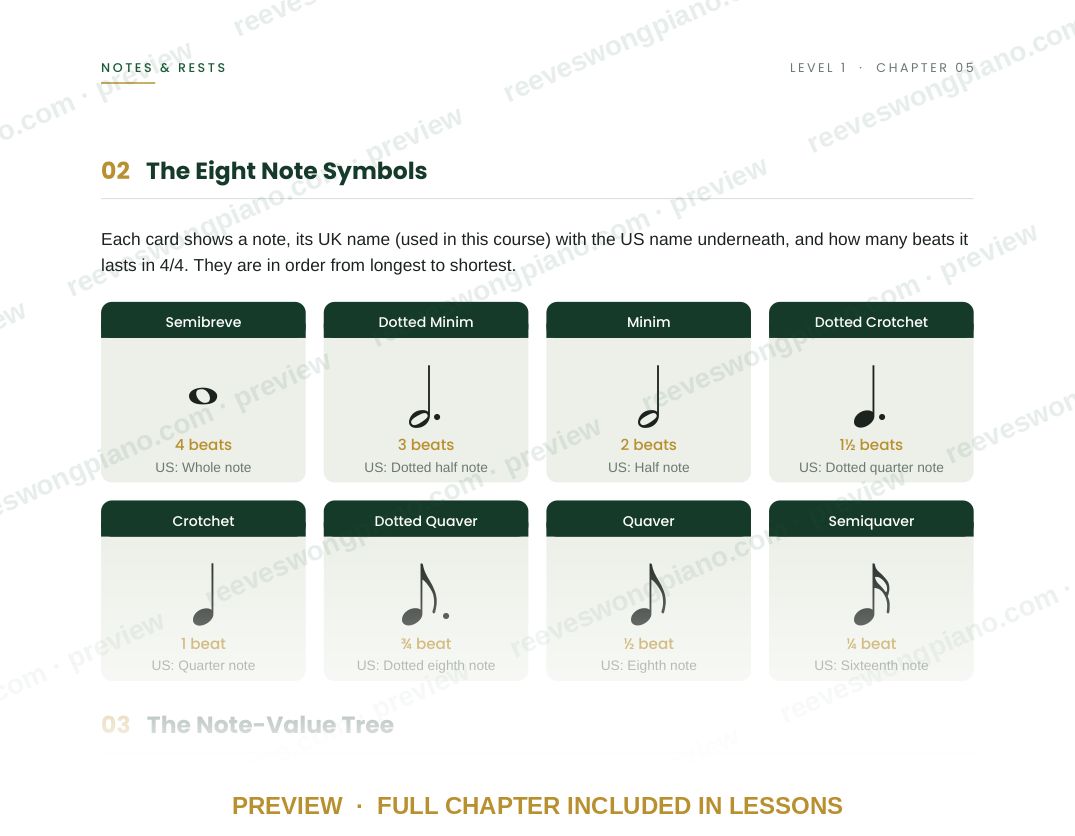
- Recognise the eight note symbols and name them in UK and US terms.
- Say how many beats each note lasts, and how the values divide in the note-value tree.
- Match every note with the rest of the same length.
- Work out dotted values — a dot adds half.
- Clap and count short rhythms, then check them with exercises.
06Bars & Time Signatures6 pages
Beats give music its pulse — but on their own they would run on forever. Bars are how we package those beats into tidy, repeating groups, and the time signature tells you how many beats each group holds.
In this chapter you will learn to
- Understand what a bar (measure) is and what barlines are for.
- Recognise single, double and final barlines.
- Read the top and bottom numbers of a time signature.
- Count and feel 4/4 and 3/4 — including the backbeat on 2 and 4.
- Find any spot in a piece by its bar number, and hear four- and eight-bar phrases.
07Counting & Steady Pulse6 pages
Reading a rhythm is only half the job. The other half is keeping the beat steady while you play it — never rushing, never stopping. That steady beat is what lets you play with a singer, a band or a track.
In this chapter you will learn to
- Count aloud in crotchets (“1 2 3 4”) and in quavers (“1 & 2 &”).
- Keep counting through rests and held notes.
- Practise with a metronome — set a tempo in bpm and start slow.
- Clap a rhythm, then play it on one note, then play along with a backing track.
- Keep going after a mistake instead of stopping.
11Right-Hand Chord Rhythms5 pages
In play and sing, your left hand gives the song its bass and your right hand plays the chord. Holding that chord works, but holding it the same way for the whole song sounds like an exercise, not music. The rhythm you give the right-hand chord is what turns a chord chart into a real song.
In this chapter you will learn to
- Play four right-hand chord rhythms in 4/4: Hold, Pulse, Ballad and Steady Quavers.
- Play the Waltz rhythm for songs in 3/4.
- Hear how the same chord played four different ways gives four different moods.
14Ties5 pages
Two curved lines in written music look almost the same but mean very different things: the tie and the slur. This chapter is about the tie — the curve that joins two note values into one longer sound, even across a barline.
In this chapter you will learn to
- Recognise a tie and play a tied note once, holding it for both values.
- Add up tied values, inside a bar and across a barline.
- Choose between a tie and a dot — and see why only a tie can cross a barline.
- Count and play tied notes in a pop melody.
- Tell a tie (same pitch) from a slur (different pitches).
Chords & Keys 8 chapters
03Semitones & Tones5 pages
Every melody, scale and chord you will ever play is built from just two distances on the keyboard: the semitone and the tone. Master these two measurements and the whole instrument starts to make sense — you can build any scale, find any chord, and move a song into any key.
In this chapter you will learn to
- Measure a semitone — the smallest step on the piano, counting black keys too.
- Measure a tone — two semitones, skipping one key.
- Spot the two white-key semitones, E–F and B–C, by sight.
- Tell a semitone from a tone anywhere on the keyboard, going up or down.
- Build the major scale from the pattern T T S T T T S — in C, G and F.
08Major & Minor Triads6 pages
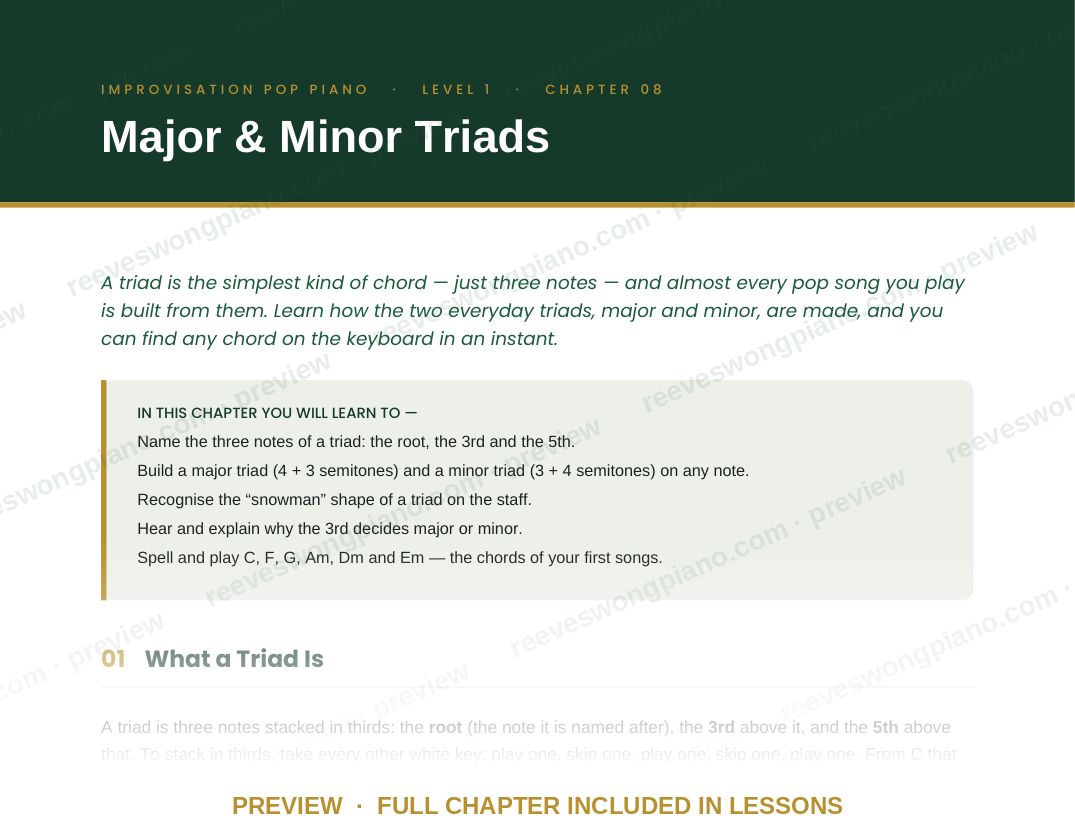
A triad is the simplest kind of chord — just three notes — and almost every pop song you play is built from them. Learn how the two everyday triads, major and minor, are made, and you can find any chord on the keyboard in an instant.
In this chapter you will learn to
- Name the three notes of a triad: the root, the 3rd and the 5th.
- Build a major triad (4 + 3 semitones) and a minor triad (3 + 4 semitones) on any note.
- Recognise the “snowman” shape of a triad on the staff.
- Hear and explain why the 3rd decides major or minor.
- Spell and play C, F, G, Am, Dm and Em — the chords of your first songs.
15C Major — Scale & Diatonic Chords6 pages
C major is the natural home of the keyboard — seven white keys, no sharps and no flats. Because there is nothing to remember about the key signature, it is the ideal key for learning a scale, its fingering and the seven chords built from it — the raw material for playing and improvising in C.
In this chapter you will learn to
- Explain what diatonic means and name the seven notes of C major by scale degree.
- See the tone–semitone pattern T–T–S–T–T–T–S that builds every major scale.
- Play the C major scale over two octaves — each hand alone, then hands together.
- Build the seven diatonic chords of C major and name them with Roman numerals (I ii iii IV V vi vii°).
- Play the four pop chords — I, IV, V and vi — and the I–V–vi–IV loop in C.
23G Major — Scale & Diatonic Chords7 pages
G major is the first key to add a sharp. Its single sharp is F♯, so six of its notes are white keys and one is black. Under the hand it is almost identical to C major — the only new thing to find is that one black key.
In this chapter you will learn to
- Explain what diatonic means and name the seven notes of G major by scale degree.
- Read the key signature of one sharp (F♯) and see why the T–T–S–T–T–T–S pattern needs it.
- Play the G major scale over two octaves — each hand alone, then hands together.
- Build the seven diatonic chords of G major and name them with Roman numerals (I ii iii IV V vi vii°).
- Play the four pop chords — I, IV, V and vi — and the I–V–vi–IV loop in G.
24F Major — Scale & Diatonic Chords7 pages
F major is the first key to add a flat. Its single flat is B♭, so six of its notes are white keys and one is black. It also brings a new right-hand habit: the thumb tucks under after the fourth finger rather than the third.
In this chapter you will learn to
- Explain what diatonic means and name the seven notes of F major by scale degree.
- Read the key signature of one flat (B♭) and see why the T–T–S–T–T–T–S pattern needs it.
- Play the F major scale over two octaves — each hand alone, then hands together.
- Build the seven diatonic chords of F major and name them with Roman numerals (I ii iii IV V vi vii°).
- Play the four pop chords — I, IV, V and vi — and the I–V–vi–IV loop in F.
25Diatonic Triads — C, G & F4 pages
You have now met three keys — C, G and F major. Put their chords side by side and a simple pattern appears: the same seven chord qualities, in the same order, in every major key. Learn the pattern once and every key becomes easier.
In this chapter you will learn to
- See the fixed pattern of chord qualities: major, minor, minor, major, major, minor, diminished.
- Read the seven diatonic chords of C, G and F major side by side.
- Find the chords two keys share — and the two chords all three share.
- Move a progression from one key to another using Roman numerals.
28Pop Progressions6 pages
A chord progression is a repeating sequence of chords that carries a song from start to finish. Name the chords with Roman numerals instead of letters and the same loop works in every key — learn it once in C major, then move it anywhere. A handful of these loops sit under a huge share of the pop and Mandopop you already know.
In this chapter you will learn to
- Read a progression in Roman numerals and play it in C, G and F major.
- Play the four core pop loops: I–IV–V–I, I–V–vi–IV, vi–IV–I–V and I–vi–IV–V.
- Hear how the starting chord changes the mood of the same four chords.
- Play every loop with your Level 1 accompaniment patterns.
29Hearing Major vs Minor4 pages
Some chords sound bright and open; others sound darker and more wistful. Hearing that difference is your first step in ear training — and it helps you find the right chords for the songs you sing.
In this chapter you will learn to
- Explain why a major chord sounds bright and a minor chord sounds darker.
- Hear the difference at the piano by playing major and minor pairs.
- Sing the 3rd of a chord and feel it move down one semitone.
- Name major or minor by ear — one chord at a time and inside a four-chord loop.
Patterns 7 chapters
09Root + Chord — Play & Sing Pattern6 pages
Your first play-and-sing pattern: root in the left hand, chord in the right, voice free to sing.
In this chapter you will learn to
- Play any chord as Root + (1+3+5) — the root in the left hand, the triad in the right.
- Play the C – G – Am – F loop from notation, changing both hands together on beat 1.
- Move between chords smoothly by keeping the hand shape and moving the whole hand.
- Play the loop in G major and F major, and sing a simple song over it.
16Left-Hand 1+3+5 — Solo Pattern5 pages
When you play solo, your right hand has the melody — so your left hand has to carry the whole chord on its own. The 1+3+5 block is the simplest, clearest way to do it.
In this chapter you will learn to
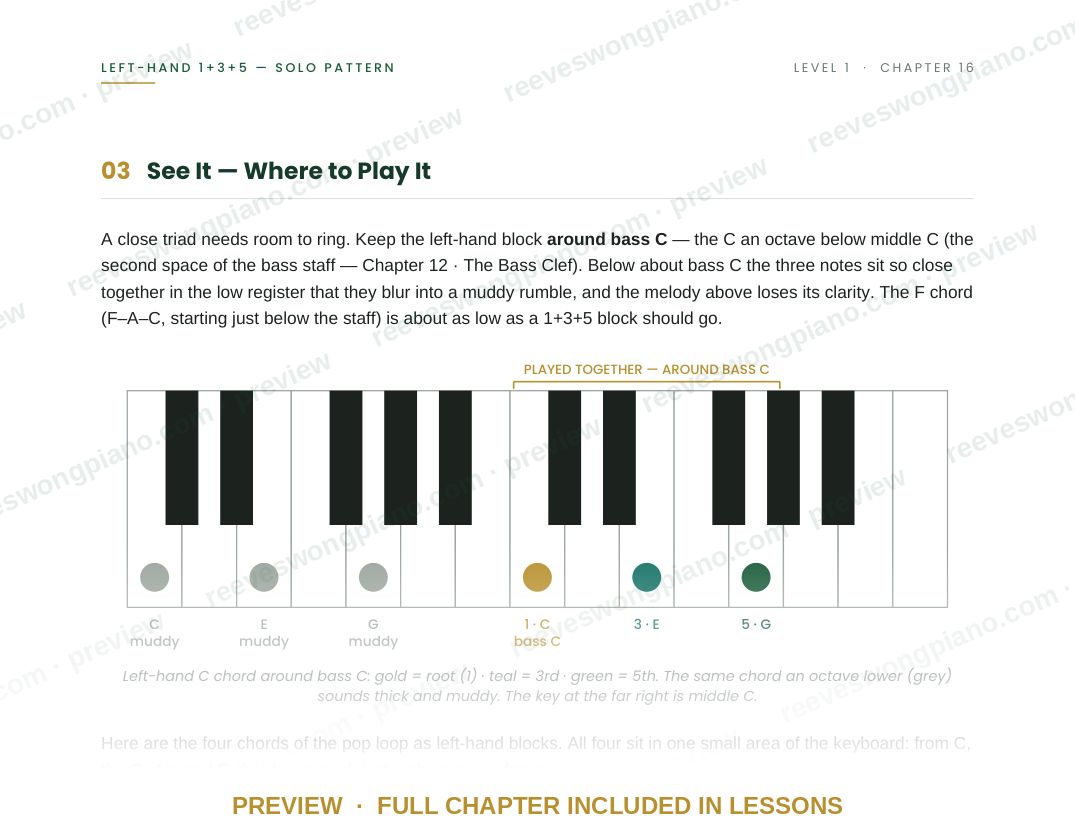
- Play any chord in C major as a left-hand 1+3+5 block around bass C.
- Explain why a solo player needs the full chord — including the 3rd — in the left hand.
- Keep the block clear rather than muddy by playing it in the right part of the keyboard.
- Play the C – G – Am – F loop with a right-hand melody on top.
- Practise hands together slowly, with the melody singing over a soft left hand.
19The Sustain Pedal6 pages
The sustain pedal is how a piano truly sings. Pressed with the right foot, it lets notes ring on after your fingers leave the keys — connecting chords, filling out the sound and adding warmth. Used well it is invisible; used carelessly it turns music to mud.
In this chapter you will learn to
- Explain what the sustain pedal does inside the piano.
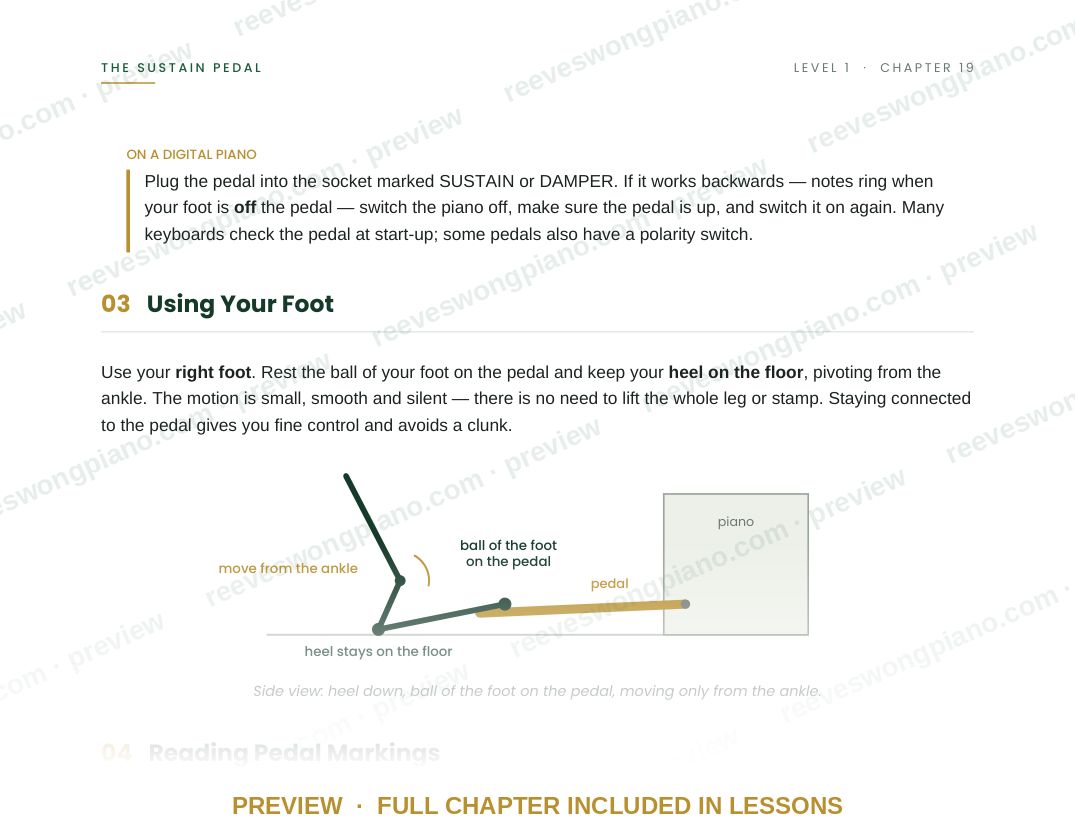
- Find the sustain pedal and place your foot correctly.
- Read pedal markings: Ped. and ✻, and the bracket line.
- Change the pedal cleanly every time the chord changes — legato pedalling.
- Play C – G – Am – F with Root + chord and a clean, connected pedal.
201–5–8 — Solo Pattern6 pages
The foundation pattern of pop piano: root, fifth and octave in the left hand, a melody in the right. Open and strong underneath, it leaves the tune free to sing on top.
In this chapter you will learn to
- Play 1–5–8 on any chord in C major with left-hand fingers 5-2-1.
- Explain why leaving out the 3rd makes the pattern safe under any melody.
- Play the rhythm crotchet – crotchet – minim in 4/4, and three crotchets in 3/4.
- Play the C – G – Am – F loop with a right-hand melody on top, in 4/4 and in 3/4.
- Practise hands together slowly, keeping the left hand steady and soft.
211–5–8 + Chord — Play & Sing Pattern6 pages
Your second play-and-sing pattern: the left hand rocks up through 1–5–8 while the right hand holds the chord — more movement, and still plenty of room for your voice.
In this chapter you will learn to
- Play any chord as 1–5–8 + (1+3+5) — a rising bass in the left hand, the triad in the right.
- Keep the left hand steady in its rhythm — crotchet, crotchet, minim — while the right hand holds.
- Play the C – G – Am – F loop from notation with Hold and Ballad rhythms, in 4/4 and in 3/4.
- Keep the hands apart when they would meet, and move between chords smoothly.
- Sing a song over the pattern.
261–5–8–5–8–5–8–5 — Solo Pattern5 pages
The open 1–5–8 set in motion. Your left hand rolls root, fifth and octave in steady quavers while your right hand sings a melody in long notes over the top.
In this chapter you will learn to
- Play the 1–5–8–5–8–5–8–5 roll in even quavers with left-hand fingers 5-2-1-2-1-2-1-2.
- Count “1 & 2 & 3 & 4 &” and keep every quaver the same length.
- Explain why the pattern fits 4/4 but not 3/4.
- Play the C – G – Am – F loop with a right-hand melody in long notes on top.
- Keep the bass light and relaxed so the melody stays in front.
271–5–8–5–8–5–8–5 + Chord — Play & Sing Pattern6 pages
Your third play-and-sing pattern: the left hand rocks between fifth and octave in eight even quavers, driving the song along while the right hand holds the chord.
In this chapter you will learn to
- Play any chord as 1–5–8–5–8–5–8–5 + (1+3+5) — a rocking bass under a held triad.
- Keep eight even quavers in the left hand, counting “1 & 2 & 3 & 4 &”.
- Play the C – G – Am – F loop from notation with the Hold and Pulse rhythms.
- Keep the bass under your voice — steady, relaxed and never rushing.
- Play the loop in G and F, and sing a song over the pattern.
Performance 3 chapters
00How to Practise4 pages
Your weekly lesson shows you what to play and how. What happens between lessons decides how fast it becomes yours. This chapter shows you how to practise well — in as little as twenty minutes a day.
In this chapter you will learn to
- See how your weekly lesson and your home practice fit together.
- Use six simple habits that make every minute of practice count.
- Plan a focused 20-minute daily session.
- Know when a chapter is “done” — and why that does not mean perfect.
- Keep a weekly practice log to bring to your lessons.
22First Improvisation6 pages
Improvising sounds like something only advanced players do. It isn't. With one simple rule you can make up your own melody over a pop chord loop today — and it will sound good from the very first note.
In this chapter you will learn to
- Understand what improvising is — and why it is not random.
- Find the chord tones (1, 3 and 5) of C, G, Am and F.
- Make up a melody over the C – G – Am – F loop using only chord tones.
- Shape your melody with space, repetition and a strong ending.
- Move smoothly between chords by choosing the nearest chord tone.
30Play and Sing6 pages
This is where Level 1 has been heading. Your hands hold the chords, your voice carries the tune — one person, one piano, a whole song from start to finish.
In this chapter you will learn to
- Understand how the hands and the voice share the work when you play and sing.
- Choose a key — C, G or F — that fits your voice, and find your first note.
- Combine the three Play & Sing patterns with the right-hand rhythms from Chapter 11.
- Shape a whole song, from a simple verse to a fuller chorus, with clean pedalling.
- Perform a complete song from a lead sheet — your Level 1 performance.
Start Level 1
Complete beginner or returning player, message me with your experience and I'll tell you where you'd start.
+65 8876 3831