
Home / Curriculum / Level 2
Curriculum · Level 2 · Months 7–12
Level 2 Chapters
The second six months of the course. 26 chapters bring in more keys, inversions for smooth chord changes, sus and slash chords, two-note harmony, three new left-hand patterns and pentatonic fills.
Chapter by chapter
Each chapter is a short illustrated guide with diagrams, notation and exercises to check yourself.
In the order that suits you
I pick the chapters for each lesson around your songs, so we don't always go in number order.
Ticked off on your map
Every chapter we cover is ticked on your Level 2 progress map, which you get with each lesson summary.
Look Inside
A few pages from Level 2. Students receive every chapter in full as part of their lessons. Tap a page to enlarge it.
All Level 2 Chapters
Grouped by the five skill lines on your progress map. Tap a chapter to see what it covers.
Reading & Rhythm 7 chapters
01Ledger Lines6 pages
The five lines of a staff can only hold so many notes. When a melody climbs higher or a bass line dips lower than the staff allows, music adds tiny extra lines called ledger lines — little extensions that let each staff keep going in both directions.
In this chapter you will learn to
- Read notes on up to two ledger lines above and below both the treble and bass staves.
- Use eight landmark notes — middle C, low A, high A, high C, low E, low C and more — instead of counting.
- See why ledger lines skip a letter each time, just like the lines inside the staff.
- Read left-hand roots written below the bass staff and find them in the right octave.
- Check your reading with exercises and a checkpoint.
02Key Signatures6 pages
A key signature is the small group of sharps or flats written just after the clef. It tells you which notes to raise or lower for the whole piece — so you read them once and apply them everywhere, instead of marking every note.
In this chapter you will learn to
- Read a key signature and apply it to every note on the line, in every octave.
- Say the order of sharps (F C G D A E B) and flats (B E A D G C F).
- Know the five Level 2 keys in detail: C, G and D (0–2 sharps) and C, F and B♭ (0–2 flats).
- Name the key from its signature — and its relative minor.
- Use the circle of fifths to see how the keys are related.
03Intervals6 pages
In Level 1 you learned to measure distance in semitones and tones. An interval simply gives that distance a name. Whenever you play or read two notes — one after the other or together — the gap between them is an interval, and naming it is the first step to building chords and reading shapes at a glance.
In this chapter you will learn to
- Name an interval's number by counting letter names — 2nd up to octave.
- Find its quality — perfect, major or minor — by counting semitones.
- Know the intervals pop music uses most: M2/m2, M3/m3, P4, P5, M6/m6 and P8.
- See the intervals inside the major and minor triads you already play.
- Recognise the common intervals by ear, and name them on the staff.
106/8 Time6 pages
6/8 has a roll to it — a gentle, swaying lilt you feel long before you can name it. It looks like six beats on the page, but your body only feels two. This is your first taste of compound time.
In this chapter you will learn to
- Count a bar of 6/8 as two big pulses, each a group of three: 1-2-3 4-5-6, or “1 & a 2 & a”.
- Tell simple time from compound time by the top number of the time signature.
- Recognise the dotted crotchet as the true beat of 6/8, and read the common 6/8 rhythms.
- Tell 6/8 apart from 3/4 — the same six quavers, grouped a different way.
- Land bass and chords on beats 1 and 4 to play a 6/8 pop-ballad accompaniment.
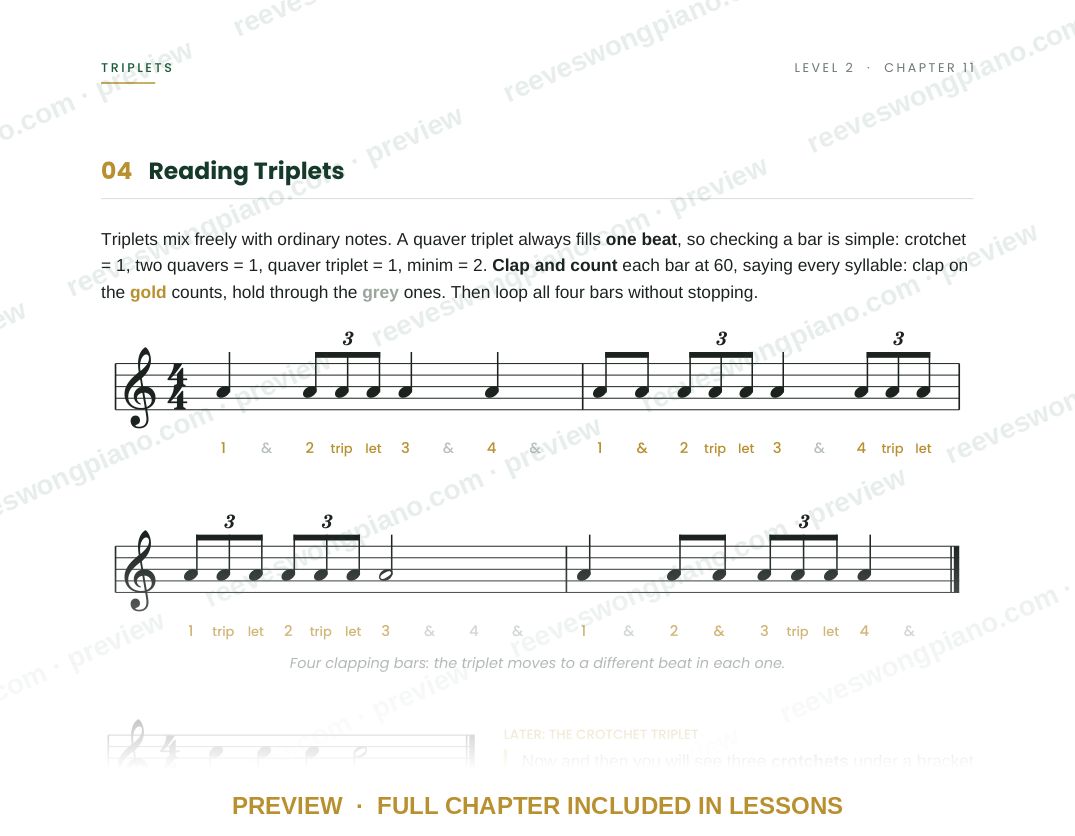
11Triplets7 pages
Three notes where there would normally be two. The triplet gives a slow ballad its rocking “trip-let, trip-let” and lets a fill roll into the next chord. It is the three-way feel of 6/8, brought into 4/4 one beat at a time.
In this chapter you will learn to
- Explain what a triplet is: three equal notes in the time of two, marked with a 3.
- Count triplets “1-trip-let” and switch smoothly between straight quavers and triplets.
- Read bars that mix triplets with crotchets and quavers, and check that every bar adds up.
- Play the triplet ballad right hand over a left-hand root or 1–5–8.
- Use a triplet as a fill into the next chord and inside a melody.
12Right-Hand Chord Rhythms II8 pages
Level 1 gave your right hand five rhythms on the beat. Now long and short chords mix, and a chord can land between the beats: dotted rhythms, the 3+3+2 pop rhythm, and a rhythm that sways in 6/8.
In this chapter you will learn to
- Count and play the dotted crotchet + quaver: “1 (2) &”.
- Play two dotted rhythms in 4/4 — Dotted Ballad and Dotted Pulse.
- Play the 3+3+2 pop rhythm, counting “1 2 3 1 2 3 1 2” and “1 (2) & (3) 4”.
- Play the 6/8 Sway and the 6/8 Ballad rhythm.
- Choose the right left-hand pattern for each rhythm.
18Song Form & Navigation6 pages
A pop song is built from sections — intro, verse, chorus — and a lead sheet uses a handful of signs to send you back and forth between them. Learn to read the map and a two-page song plays like a five-minute performance, with no wrong turns.
In this chapter you will learn to
- Name the sections of a pop song and say what each one does.
- Read D.C., D.S., Fine, the segno and the coda sign — and “al Fine” and “al Coda”.
- Combine them with the repeat signs and endings from Level 1 · Chapter 18 · Repeat Signs & Endings.
- Trace a complete lead sheet and write its playing order bar by bar.
- Change what your hands do from section to section so the song builds.
Keys 5 chapters
09D Major — Scale & Diatonic Chords8 pages
D major is a bright, singer-friendly key heard constantly in pop and rock. It has two sharps — F♯ and C♯ — so five of its notes are white and two are black, yet the hand keeps exactly the same shape as C major.
In this chapter you will learn to
- Explain what diatonic means and name the seven notes of D major by scale degree.
- Read the key signature of two sharps (F♯ C♯) and see why the T–T–S–T–T–T–S pattern needs them.
- Play the D major scale over two octaves — each hand alone, then hands together.
- Build the seven diatonic chords of D major and name them with Roman numerals (I ii iii IV V vi vii°).
- Play six easy progressions in D, moving smoothly between chords with inversions.
14Relative Major & Minor6 pages
Every major key has a partner — its relative minor — and they are closer than they look. A relative major and minor share the very same key signature (the same seven notes); they simply treat a different note as home. That one change is enough to turn bright into wistful.
In this chapter you will learn to
- Explain what makes two keys relative, and why they share one key signature.
- Find the relative minor of C, G, F, D and B♭ major — on the 6th degree, or three semitones down.
- Find the relative major of A, E, D, B and G minor — on the 3rd degree, or three semitones up.
- Play a major scale and its relative natural minor, and hear the different home note.
- Tell from the chords whether a song with a given key signature is in the major or the minor key.
15Minor Scales7 pages
Where major scales sound bright, minor scales carry the moody, emotional colour behind so much pop and film music. Pop uses two forms most — natural and harmonic minor — and you will learn both in the five minor keys that partner your major keys: A, E, D, B and G minor.
In this chapter you will learn to
- Explain what makes a scale sound minor.
- Play the natural minor scale in A, E, D, B and G minor.
- Build the harmonic minor by raising the 7th — and explain why that makes the V chord major.
- Play both forms with the correct fingering, each hand alone and hands together.
- Use the major V chord to bring a minor-key progression home.
16B♭ Major — Scale & Diatonic Chords8 pages
B♭ major is a warm key heard all over jazz, pop and brass writing. It has two flats — B♭ and E♭ — and because its home note is a black key, both hands begin on a finger other than the thumb. The two-octave shape is worth learning slowly and evenly.
In this chapter you will learn to
- Explain what diatonic means and name the seven notes of B♭ major by scale degree.
- Read the key signature of two flats (B♭ E♭) and see why the T–T–S–T–T–T–S pattern needs them.
- Play the B♭ major scale over two octaves — each hand alone, then hands together.
- Build the seven diatonic chords of B♭ major and name them with Roman numerals (I ii iii IV V vi vii°).
- Play six easy progressions in B♭, moving smoothly between chords with inversions.
22Diatonic Triads in Five Keys6 pages
In Level 1 you met the seven chords of C, G and F major side by side. Level 2 adds two more keys — D major and B♭ major. The same seven chord qualities appear in the same order in all five, so one pattern gives you thirty-five chords.
In this chapter you will learn to
- Say the quality pattern of the seven diatonic triads: major, minor, minor, major, major, minor, diminished.
- Name the seven diatonic chords of C, G, D, F and B♭ major.
- Find the chords two keys share — and see why neighbouring keys share the most.
- Play I – V – vi – IV in all five keys with smooth inversions.
- Transpose a progression from C to any of the other four keys using Roman numerals.
Chords 7 chapters
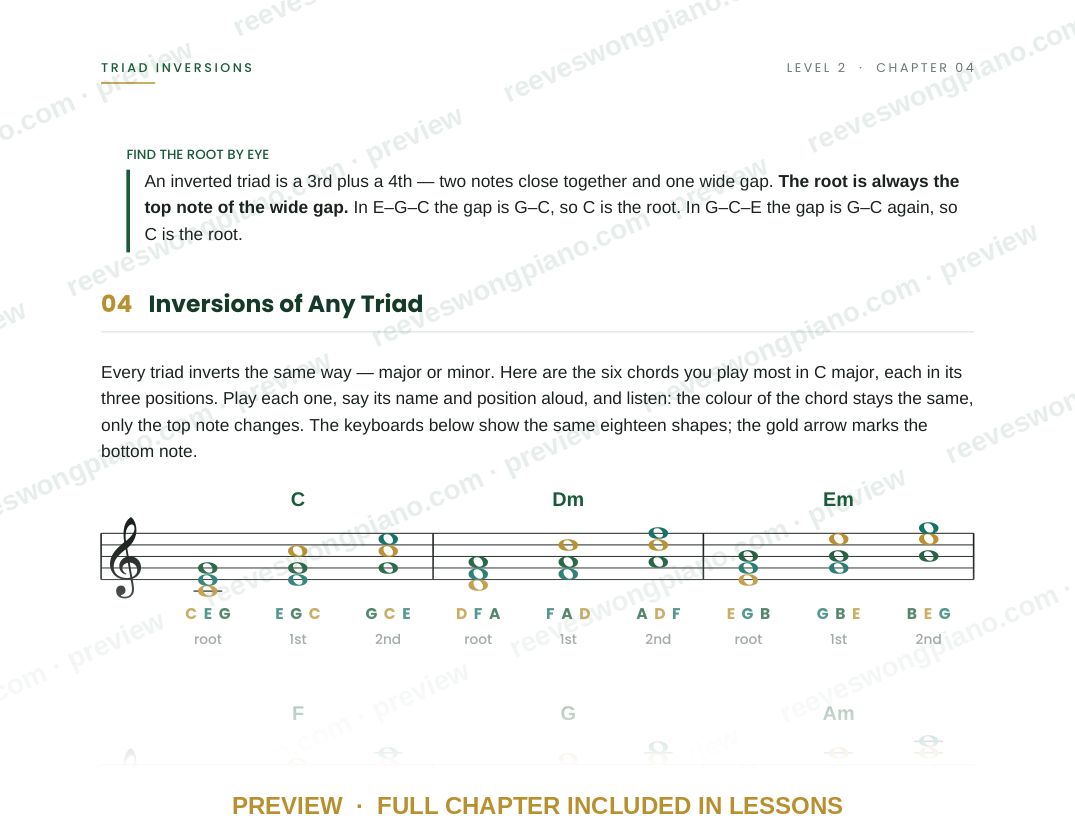
04Triad Inversions6 pages
So far every chord has been in root position — its root on the bottom. An inversion simply puts a different chord tone at the bottom. The notes don’t change and the chord keeps its name; only the order changes. Inversions are the key to smooth chord changes, smooth bass lines and reading slash chords.
In this chapter you will learn to
- Explain what an inversion is — the same three notes with a different note at the bottom.
- Build 1st and 2nd inversion by moving the bottom note up an octave.
- Name any inversion from its bottom note — root, 3rd or 5th — and find the root by eye.
- Play C, Dm, Em, F, G and Am in all three positions, on the staff and on the keys.
- Recognise inversions written as slash chords (C/E, C/G) on a lead sheet.
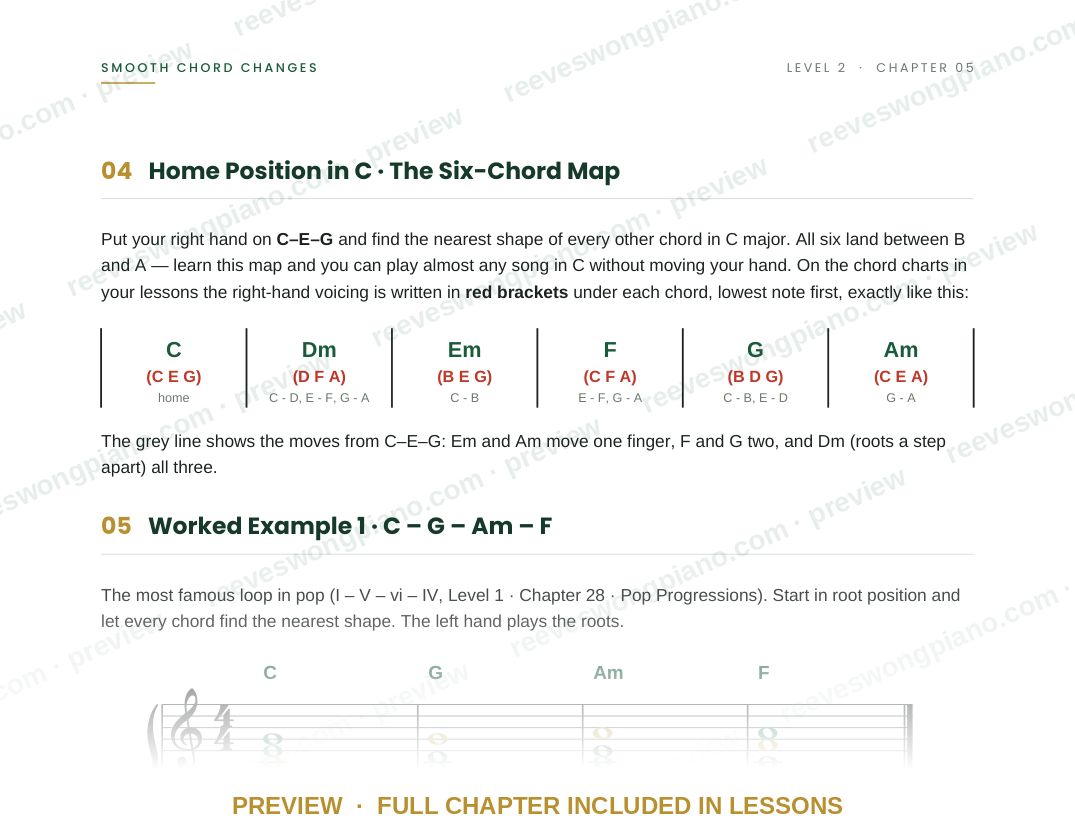
05Smooth Chord Changes6 pages
In Level 1 every right-hand chord sat in root position, so your hand jumped from shape to shape. Now that you know inversions, you can do what pop pianists do: keep the hand still and move each finger only as far as it has to. The chords sound joined-up, and the playing feels effortless.
In this chapter you will learn to
- Find the common tones between two chords and keep them on the same keys.
- Move the other notes to the nearest note of the new chord — usually a single step.
- Choose the nearest inversion for every chord in C–G–Am–F, C–F–G–C and Am–F–C–G.
- Use the voice-leading map to predict how any two chords connect.
- Play a whole progression in one hand position, with three-note voicings.
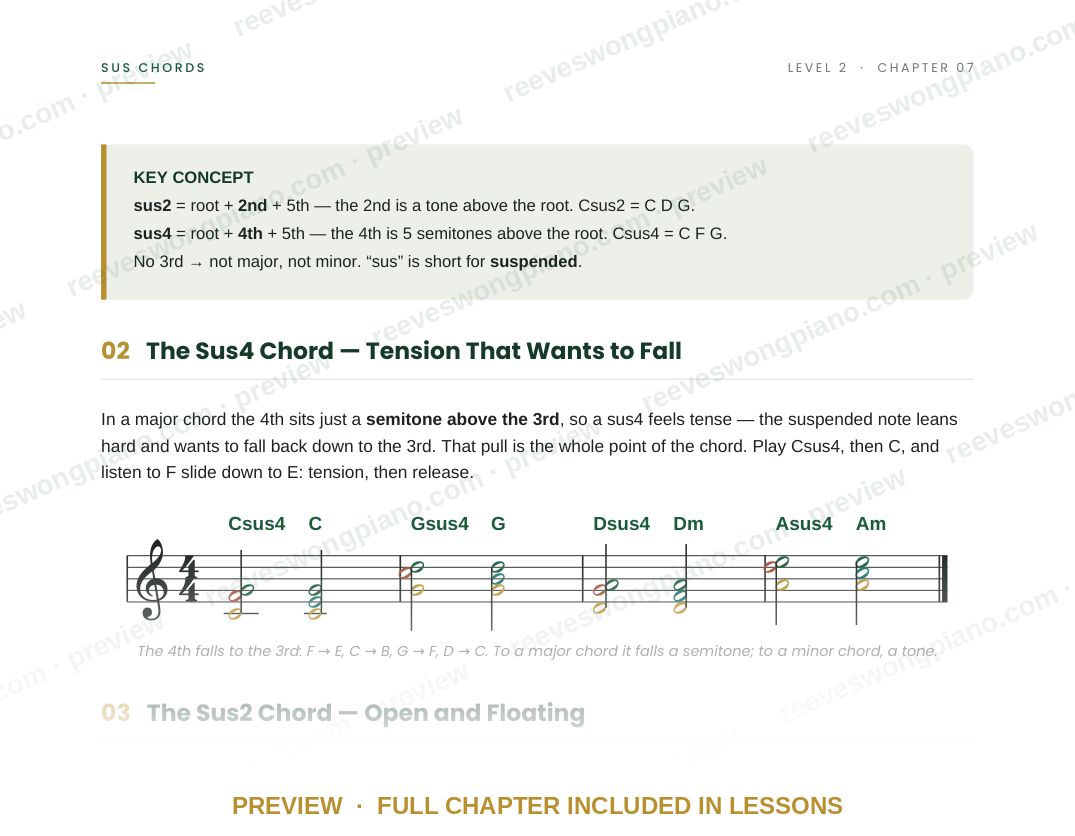
07Sus Chords6 pages
The 3rd of a chord is the note that makes it major or minor. A suspension replaces that 3rd with the note just below it or just above it — the 2nd or the 4th — leaving an open, unresolved chord that rings beautifully and is heard all over pop.
In this chapter you will learn to
- Build a sus2 and a sus4 chord on any root by replacing the 3rd.
- Hear the difference: sus4 is tense and leans; sus2 is open and floating.
- Resolve a suspension — the 4th falls to the 3rd, the 2nd rises to the 3rd.
- Read sus chord symbols and play them on the staff and the keyboard in C, G, F, D and B♭.
- Use sus chords in pop: before a chorus, in an intro, to add movement to a held chord.
08Slash Chords6 pages
A slash chord lets you choose which note sits in the bass, separately from the chord itself. It is the secret behind smooth, singable bass lines in pop — and it is written with a simple slash: chord / bass.
In this chapter you will learn to
- Read a slash chord: the chord on the left, the bass note on the right.
- Play it: the left hand plays the single bass note, the right hand plays the three-note triad.
- Tell inversion slash chords (C/E, G/B) from other-bass slash chords (F/G, Am/G).
- Play descending bass lines such as C – G/B – Am – F.
- Choose smooth right-hand shapes over a moving bass.
17Cadences6 pages
A cadence is the way a musical phrase comes to rest — the chord or two at the end of a line that tells the ear to pause, finish, or carry on. Cadences are music's punctuation. Here are the four you'll use most, in C major and in G major.
In this chapter you will learn to
- Explain what a cadence is and why it works like punctuation.
- Play the perfect, plagal, imperfect and interrupted cadences in C and in G, with smooth inversions.
- Hear how each one feels — final, gentle, unfinished or surprising.
- Recognise where cadences fall in a pop song: verse, chorus and ending.
- Name a cadence from its chords, from notation and from a chord chart.
19Two-Note Harmony7 pages
A single-note melody can sound thin. Add a harmony note underneath and the tune becomes full, warm and singing — the two favourites are a 3rd and a 6th below.
In this chapter you will learn to
- Add a harmony note a 3rd below or a 6th below any melody note, staying in the key.
- See why some 3rds and 6ths come out major and some minor — automatically.
- Choose the harmony note from the chord (locked-in) or the scale (smooth and flowing).
- Use the 1–3–5 rule to pick the 3rd or 6th that is a chord tone.
- Harmonise a whole melody over C – G – Am – F and play it with your left-hand pattern.
23Pop Progressions II8 pages
You already know the core pop loops as plain triads. This chapter dresses them up the Level 2 way — slash chords that make the bass walk, minor keys, and sus chords that lean and resolve. Same shapes, richer colour: the quickest way to make a basic loop sound produced.
In this chapter you will learn to
- Play the two long loops from the Level 1 catalogue — the Canon and the Royal Road.
- Play loops in a minor key, including the harmonic-minor V chord.
- Build descending bass lines with slash chords: C – G/B – Am – F and longer.
- Add sus4 and sus2 resolutions to any loop, in two or three keys.
Patterns 3 chapters
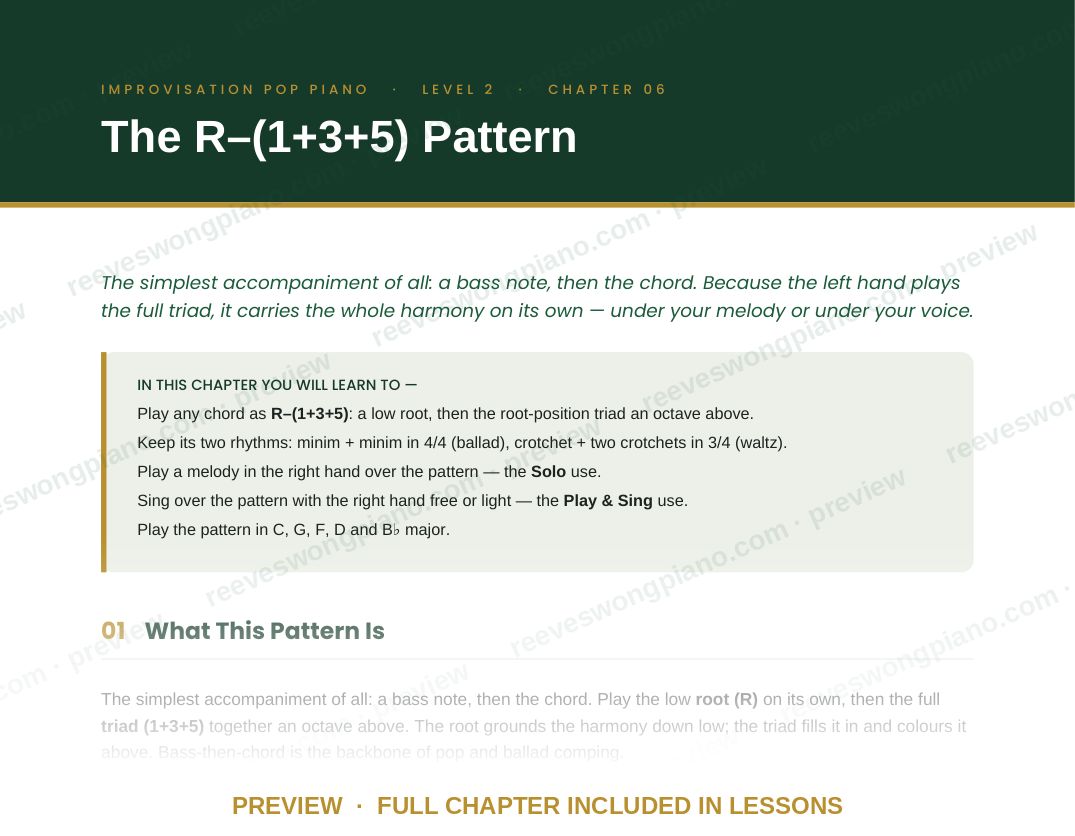
06The R–(1+3+5) Pattern7 pages
The simplest accompaniment of all: a bass note, then the chord. Because the left hand plays the full triad, it carries the whole harmony on its own — under your melody or under your voice.
In this chapter you will learn to
- Play any chord as R–(1+3+5): a low root, then the root-position triad an octave above.
- Keep its two rhythms: minim + minim in 4/4 (ballad), crotchet + two crotchets in 3/4 (waltz).
- Play a melody in the right hand over the pattern — the Solo use.
- Sing over the pattern with the right hand free or light — the Play & Sing use.
- Play the pattern in C, G, F, D and B♭ major.
13The R–5–(3+5+1) Pattern7 pages
Built from the bottom up: root, fifth, then the full chord. Your second Level 2 left-hand pattern — and the first that puts an inversion to work inside the left hand.
In this chapter you will learn to
- Play any chord as R–5–(3+5+1): root, fifth, then the triad in 1st inversion, struck together.
- Name the (3+5+1) block as the 1st inversion of the chord (Chapter 04).
- Keep its two rhythms: crotchet, crotchet, minim in 4/4; three crotchets in 3/4.
- Play a melody over the pattern (Solo) and sing over it (Play & Sing).
- Play the pattern in C, G, F, D and B♭ major.
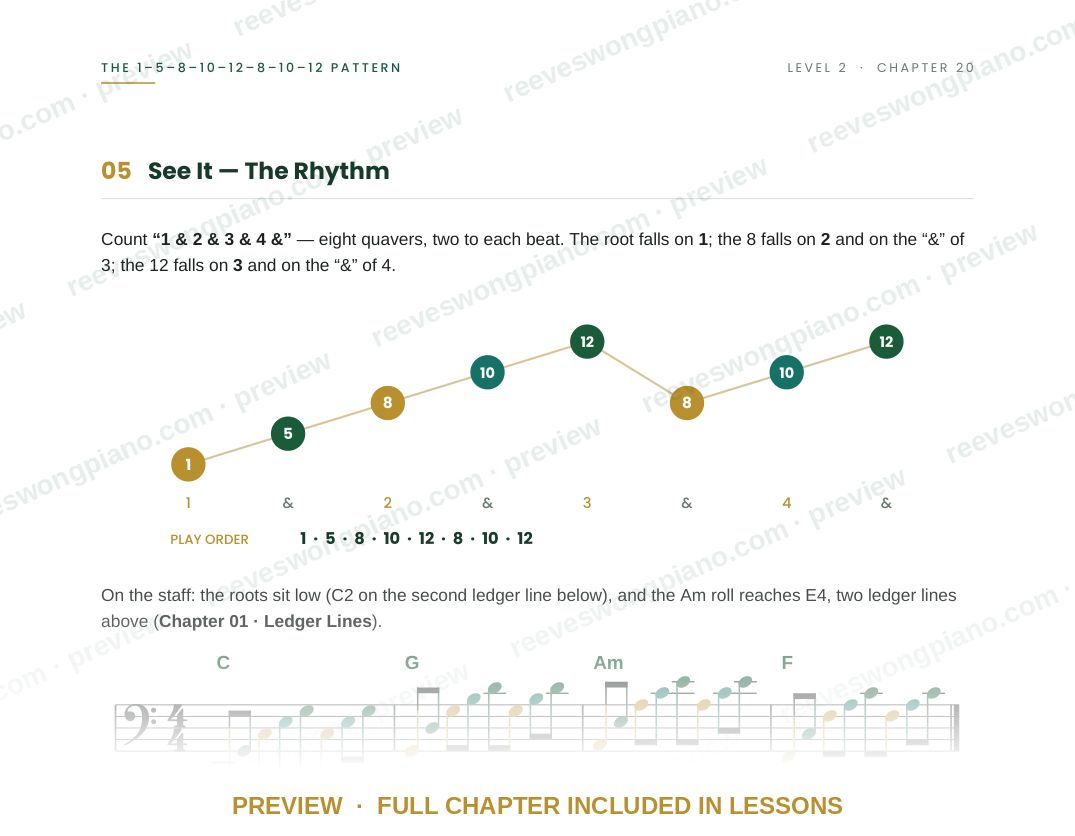
20The 1–5–8–10–12–8–10–12 Pattern9 pages
A settled bass with the triad shimmering above it. Your third Level 2 pattern rolls in eight even quavers, harp-like — and like the other two, it carries the full harmony on its own.
In this chapter you will learn to
- Play 1–5–8–10–12–8–10–12 on any chord in eight even quavers, counting “1 & 2 & 3 & 4 &”.
- Name 8, 10 and 12 as the root, 3rd and 5th one octave up.
- Move the hand between two positions: 1–5, then 8–10–12 one octave higher.
- Play a melody over the pattern (Solo) and sing over it (Play & Sing).
- Play the pattern in C, G, F, D and B♭ major.
Performance 4 chapters
21The Pentatonic Scale & First Fills7 pages
Five notes, no wrong ones. The pentatonic scale is the sound of pop fills, riffs and solos — and once your fingers know it, you can answer any melody with a short fill of your own.
In this chapter you will learn to
- Build the major pentatonic scale — notes 1, 2, 3, 5 and 6 of the major scale.
- Play it in C, G, F, D and B♭ major, and find it on the keyboard and the staff.
- Explain why it sits so safely over the main pop chords.
- Play six short fills over C – G – Am – F, at the end of a phrase or under a held chord.
- Start writing fills of your own.
24Improvising with the Pentatonic6 pages
In Level 1 you improvised with chord tones, changing your notes with every chord. Now you have five notes that fit the whole loop — the pentatonic — and a few simple tools that turn them into solos that sound like real music.
In this chapter you will learn to
- Improvise with C pentatonic over C – G – Am – F and Am – F – C – G.
- Aim for a chord tone on beat 1 of every bar — your target.
- Shape ideas with call and response and short rhythm motifs.
- Leave space, so your solo breathes like a singer.
- Plan and write a solo of your own with a simple five-step system.
25Hearing Chord Changes6 pages
In Level 1 you learned to hear whether a chord is major or minor. Now hear which chord it is. Four chords — I, IV, V and vi — carry most pop songs, and each has its own character. Learn those four sounds and you can work out a song's chords by ear.
In this chapter you will learn to
- Follow the bass line and hear when the chord changes.
- Tell I, IV, V and vi apart by their character and by three quick tests.
- Sing the bass note of each chord against the key note.
- Write down the numerals of a four-chord loop after hearing it twice.
26Play and Sing II8 pages
Level 1 ended with you singing a song over simple chords. Level 2 ends with a whole arrangement: an intro, verses and a chorus, smooth inversions, a walking bass, a fill and a proper ending — all while you sing. This is your Level 2 performance.
In this chapter you will learn to
- Read and follow a lead sheet with a segno, To Coda and D.S. al Coda.
- Play an intro with smooth inversions, a falling slash-chord bass and a pentatonic fill.
- Accompany your voice with the R–(1+3+5) pattern in the verse.
- Drive the chorus with a slash-chord bass line and the 3+3+2 right-hand rhythm.
- Perform a complete song from start to finish — your Level 2 performance.
Start Your Lessons
Complete beginner or returning player, message me with your experience and I'll tell you where you'd start.
+65 8876 3831